This post contains affiliate links. As an Amazon Associate, Home Sweet Eclectic earns from qualifying purchases. Read our affiliate disclosure.
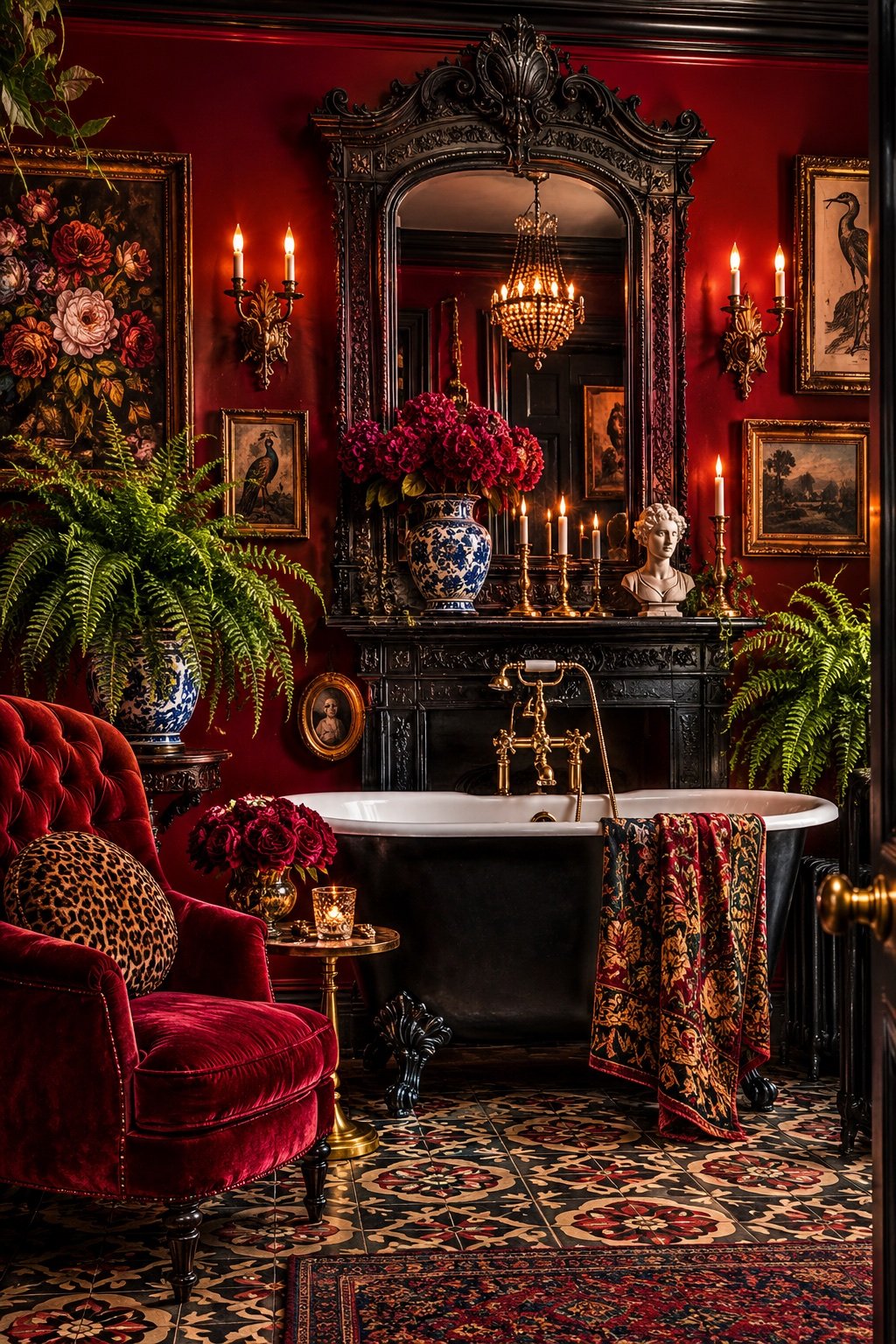
Almost every roundup of Victorian bathroom ideas on the internet shows you the same room: white subway tile, a beadboard panel, one brass hook, and a sprig of eucalyptus hung from the shower head like an apology. That is not Victorian. That is a farmhouse rental with delusions. The actual Victorians tiled floor to ceiling in patterns that fight each other, papered the walls above it, hung heavy framed art in a room full of steam, and put a cast-iron tub in the middle of the floor like a throne.
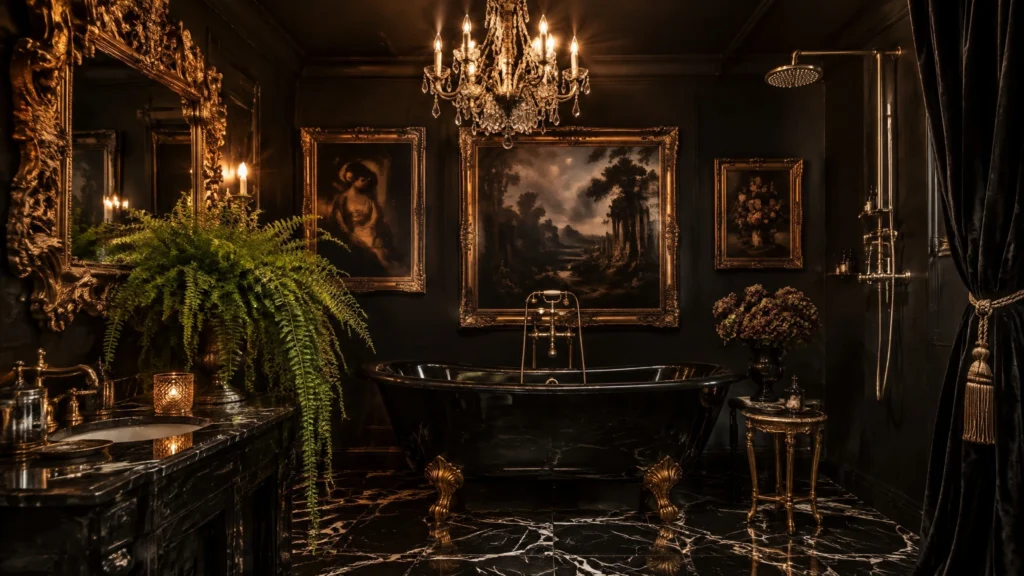
We’re doing it that way. Dark, patterned, layered, ornate to the point of being slightly unreasonable — because more is a religion, and a bathroom is the smallest room in the house, which means it’s the cheapest room to go completely overboard in. Fifteen ideas, all of them stealable.
What Separates Real Victorian Bathroom Ideas From Beige Nostalgia
Three things. Pattern on the floor, weight on the walls, and metal that’s allowed to age. Get those right and a builder-grade box turns into something that looks like it survived from 1890. Get them wrong and you’ve got a white bathroom with a vintage-looking faucet in it.
The other thing to understand is that Victorians were not restrained people. They combined a patterned floor, a tiled dado, a papered upper wall, and a painted ceiling in a room the size of a closet, and they did it on purpose. Restraint came later and ruined everything.
1. Oxblood Above, and Don’t Stop at the Chair Rail
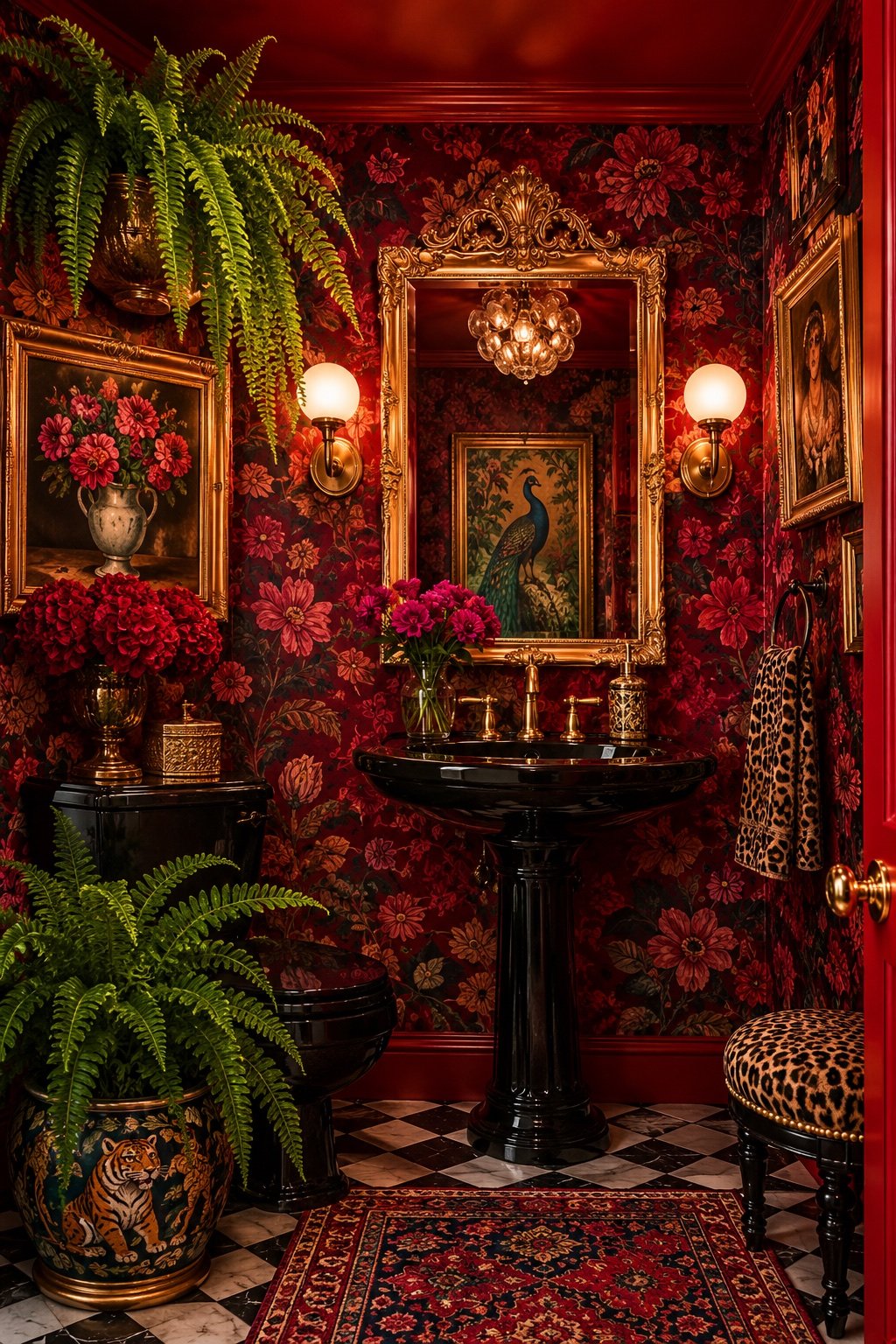
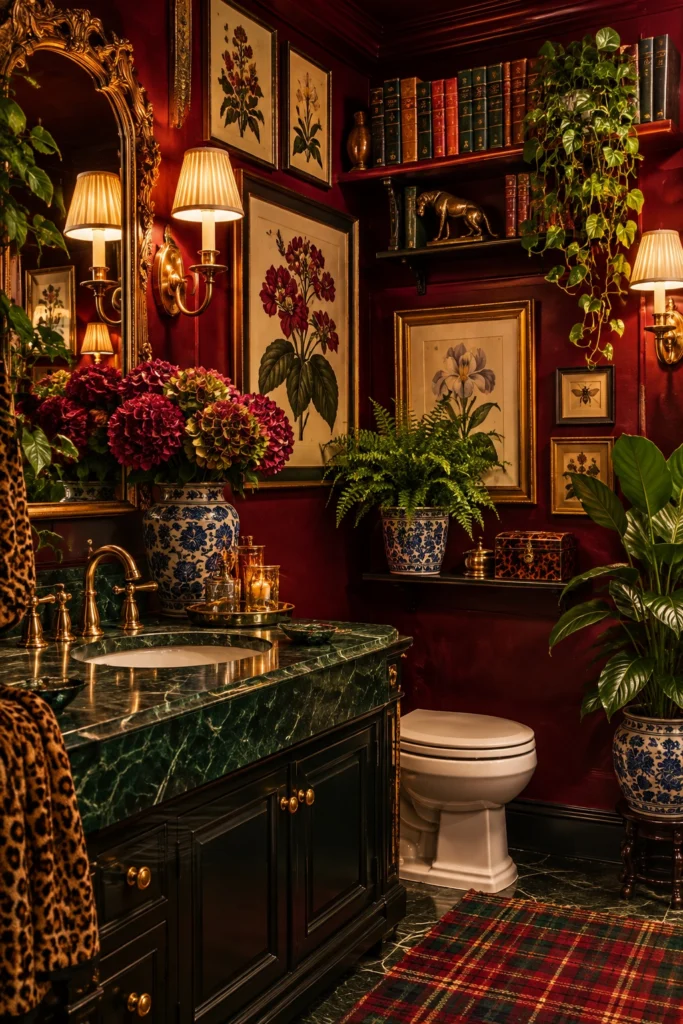
Pick a deep, slightly dirty color — oxblood, bitter plum, hunter green, a brown that’s nearly black — and take it across the upper wall and straight over the ceiling. The instinct to leave the ceiling white in a small room is the single most persistent piece of bad advice in decorating. It draws a hard line at the top of the room and announces the exact dimensions of the box you’re standing in.
Color the ceiling and the room stops having a lid. In a windowless powder room this is close to magic: the space reads as a lit interior of indeterminate size rather than a small white cube with a person in it.
2. A Clawfoot Tub With a Black Exterior
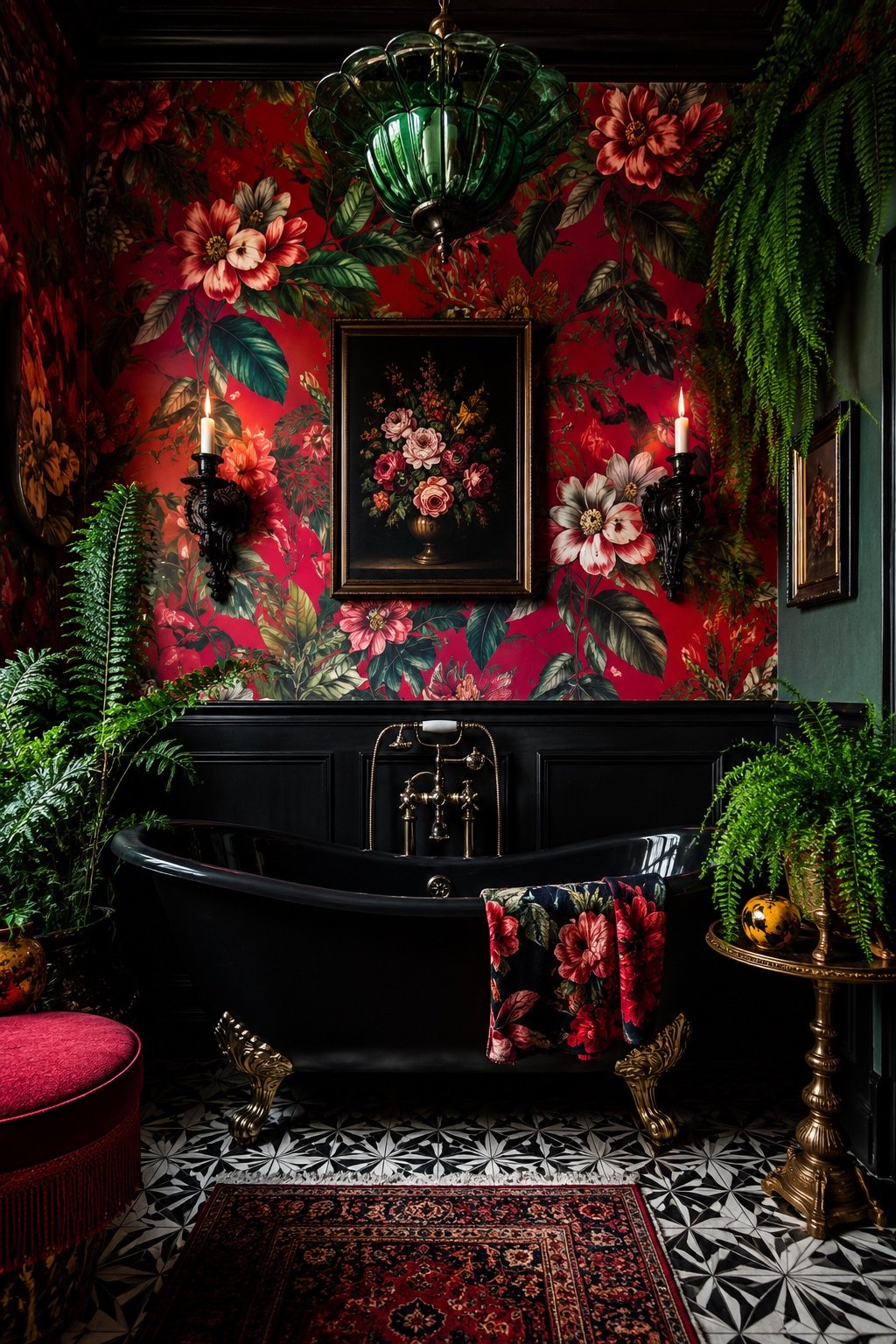
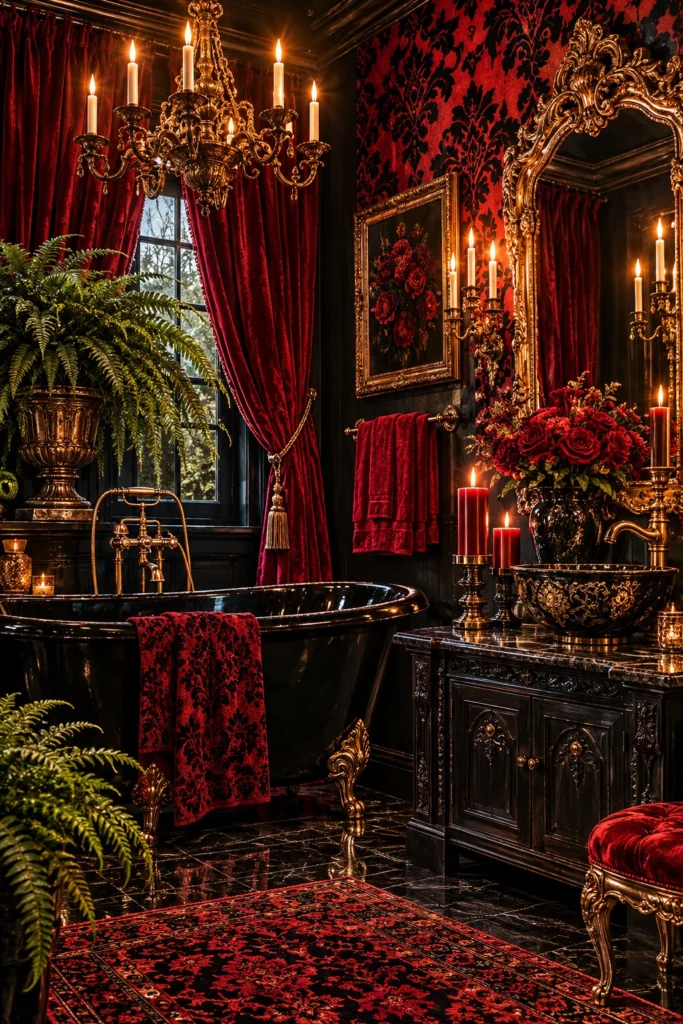
The single highest-impact move available. A cast-iron clawfoot tub with a glossy black or deep green exterior and ornate feet does more for the room than every other decision combined, and it flips the whole mood of the space — the same burgundy floral wallpaper reads sweet behind a white tub and genuinely sinister behind a black one.
Position it away from the wall if the floor plan allows even six inches of clearance. A tub floating free in the room is the defining Victorian image; a tub shoved into a corner is just a tub.
Reglazing a secondhand cast-iron tub costs a fraction of buying new, and the feet can be stripped and repainted in an afternoon. Salvage yards are full of them because they weigh three hundred pounds and terrify most renovators.
3. Encaustic Floor Tile Doing Far Too Much
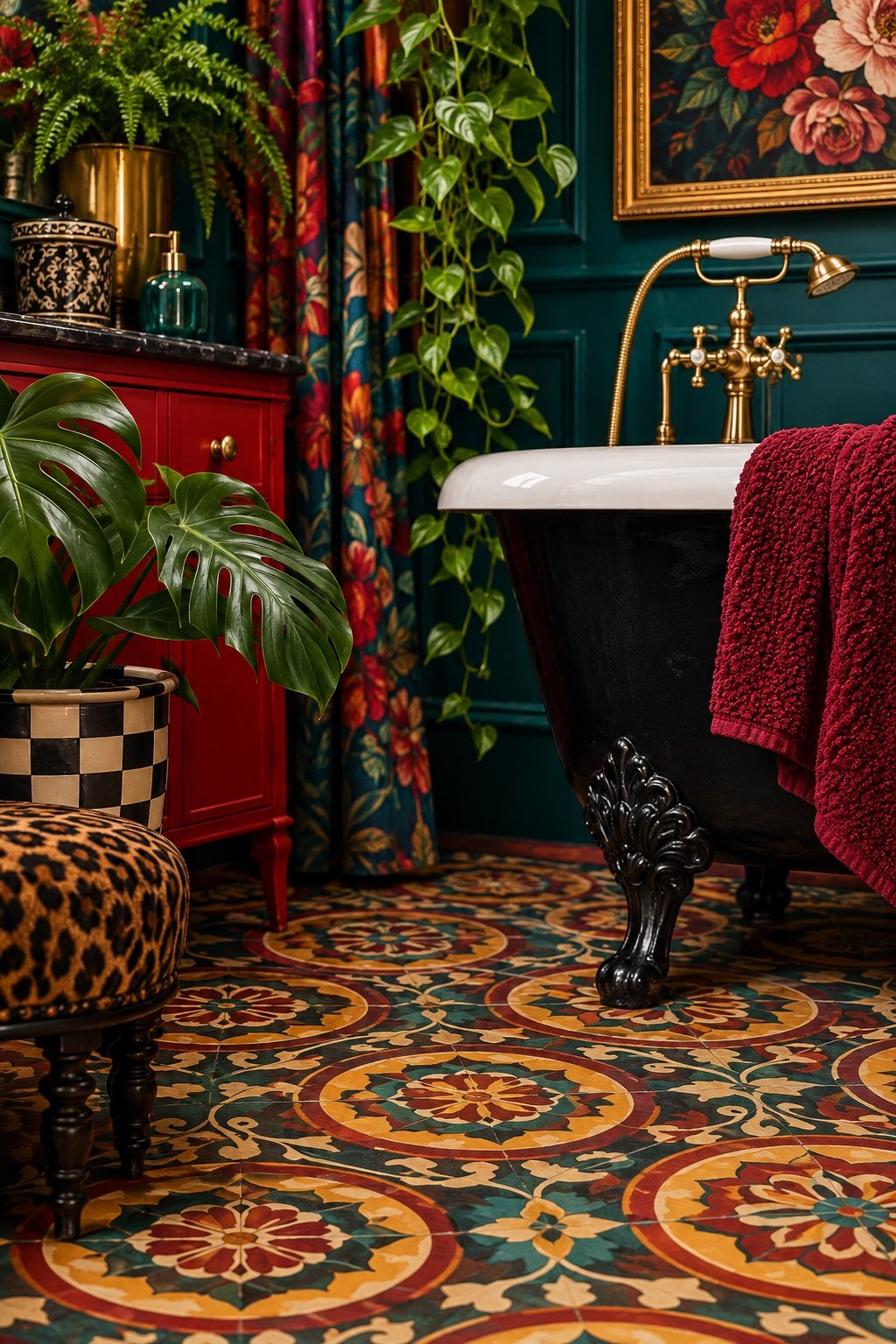
The floor is where Victorian bathroom ideas either land or collapse. You want geometric encaustic or cement tile in a busy repeating pattern — black and white, or ochre and oxblood, or a deep green Moorish star that makes the room look older than the house. Small-scale, high-contrast, relentless.
Run it wall to wall with no border and no transition strip. The pattern should feel like it was laid before the fixtures arrived and the fixtures were placed on top of it.
Porcelain reproductions of Victorian encaustic-look floor tile are cheap, sealed, and genuinely convincing underfoot, which matters in the one room where everything gets wet.
4. Unlacquered Brass, Cross Handles, No Exceptions
Every piece of metal in the room should be brass, bronze, or nickel that’s been allowed to go dull — and every handle should be a cross or a lever, never a single modern mixer. Exposed pipework is a feature, not a flaw. A visible brass P-trap under a wall-mounted basin is period-correct and looks expensive precisely because nobody hides plumbing anymore.
Unlacquered brass will go blotchy and uneven within a year. That is the entire point. Lacquered brass stays looking like a 2019 kitchen faucet forever, which is a fate worse than chrome.
A cross-handle unlacquered brass basin faucet and a matching exposed tub filler with a telephone shower handset cover the two fixtures that get looked at most.
5. Wainscoting to Shoulder Height, Painted Dark
Not the 32-inch chair-rail height every contractor defaults to — run the paneling up to roughly five feet, which is where Victorian dados actually sat. Beadboard, tongue-and-groove, or picture-frame molding, painted the same deep color as the upper wall or one shade darker.
The high dado does something specific to proportion: it compresses the lower two-thirds of the room and makes the papered section above feel like a frieze. It also solves the practical problem of splash on the wall behind a freestanding basin.
6. Burgundy Florals Above the Paneling
Above the dado, paper it. A dark ground with a dense repeating floral, a William Morris–style trailing pattern, a damask, or a botanical print gone slightly muddy with age. The darker the ground, the better this works — pale floral wallpaper in a bathroom reads as a bed and breakfast, while the same pattern on a near-black ground reads as a house with a history.
Modern vinyl and non-woven papers handle bathroom humidity if the room has any ventilation at all. Keep it off the direct shower wall and it will outlast your interest in it.
Your empty wall is a missed opportunity, and the four square feet above a toilet is still a wall.
7. A Marble Washstand on Exposed Legs
Kill the box vanity. What you want is a console washstand — a marble or honed slate top on slim brass or cast-iron legs, with the pipes showing underneath and a folded towel on a rail below. Visible floor under the basin makes a small bathroom read considerably larger than a cabinet sitting flat on it.
Marble with heavy grey veining, or a dark green and gold stone, both work far better here than anything white and uniform. Victorian bathrooms used whatever slab was local and strange.
A marble-top console washstand with brass legs handles this in one purchase, and the storage you lose can be recovered with a tall cabinet or an open shelf.
8. A High-Tank Pull-Chain Toilet, If You Dare
A wall-mounted cistern with a long brass pipe and a pull chain is the most committed thing you can install in a bathroom, and it is very funny in the best way. Guests will pull it and then say something about it. That is a design outcome.
If a genuine high-tank is too much plumbing, a skirted floor-mount toilet in a period profile with a wooden seat and brass hinges gets eighty percent of the effect for a tenth of the trouble. The wooden seat is doing most of the work.
9. An Overmantel Mirror Instead of a Bathroom Mirror
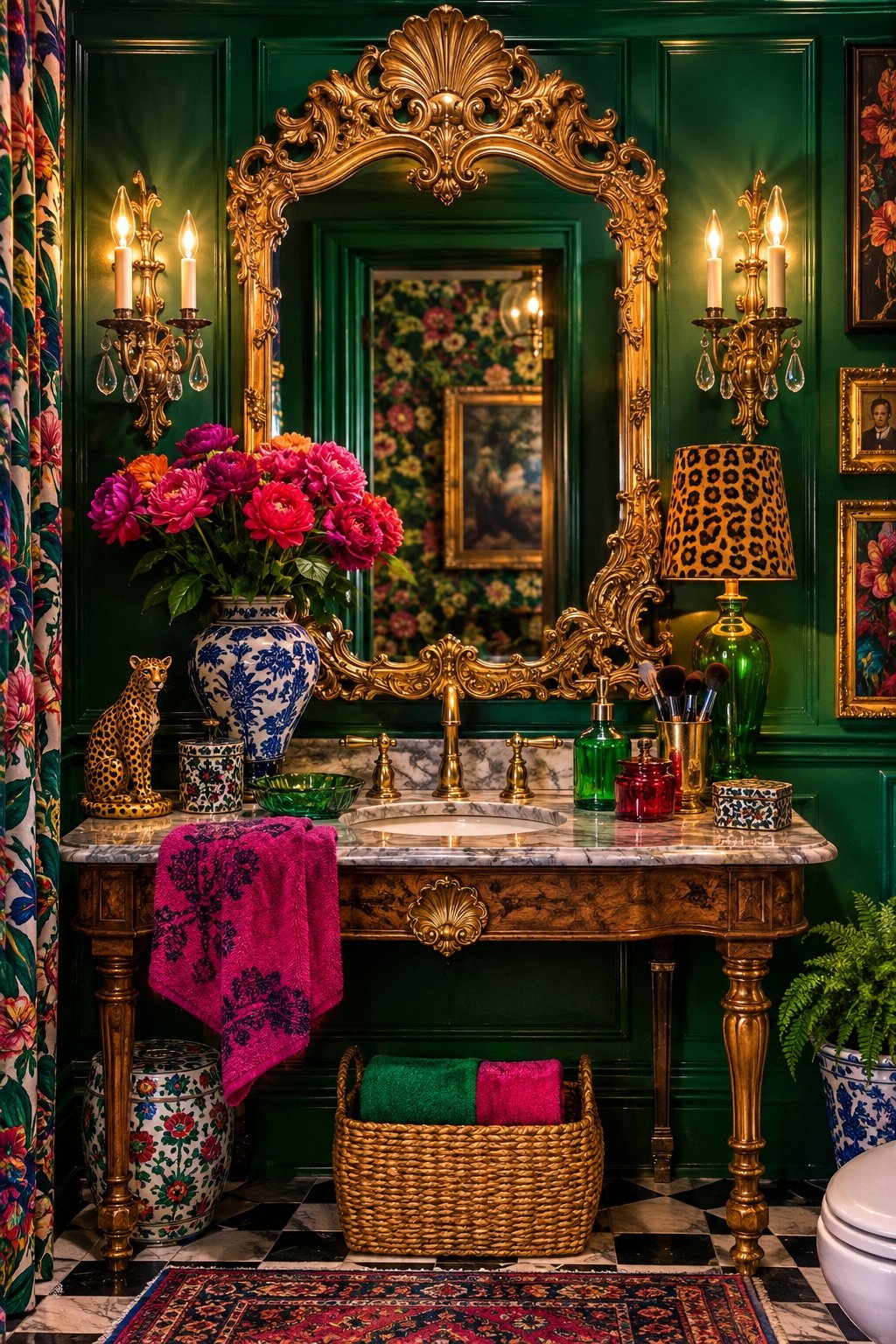
Do not hang a frameless rectangle over the basin. Hang a mirror that came out of a living room — an arched overmantel with a carved gilt frame, a foxed antique with black spots creeping in from the edges, a heavy ebonized oval. Oversize it so it’s wider than the basin below.
Foxing and spotted silvering are features. An antique mirror that’s degrading slightly reads as inherited, and it also flatters everyone standing in front of it, which is arguably the mirror’s job.
10. Candle Sconces, Flanking — Never a Vanity Bar
The horizontal light bar over the mirror is the most modern object in most bathrooms and it has to go. Replace it with a pair of brass sconces mounted at roughly eye level on either side of the mirror, shaded in pleated fabric, milk glass, or nothing at all if the bulb is a decent filament.
Side lighting at face height is also objectively better light — it eliminates the overhead shadow that makes everyone look like they’ve had a hard decade. Period-correct and flattering is a rare combination.
Add a third source low down if you can: a small pair of antique brass wall sconces by the tub, or a plug-in picture light over the art, on a dimmer for the 11pm version of the room.
11. Framed Art, Hung in the Steam
Victorians hung pictures everywhere, bathrooms included, and the modern conviction that art can’t go near humidity is mostly just timidity. Dark oil-look landscapes, botanical plates, framed anatomical prints, a small portrait of someone unrelated to you looking mildly disappointed. Mismatched gilt and dark wood frames, hung in a tight cluster.
Use prints and reproductions rather than anything irreplaceable, seal the frame backs, and keep them off the wall directly adjacent to the shower. In a ventilated room they’ll last for years.
12. Dark Grout, and Tile That Goes Higher Than You Think
If you’re tiling the walls, take it up to the dado line at minimum and use charcoal or black grout. Dark grout turns white or cream tile from a hygiene statement into a graphic pattern — suddenly the grid is the decoration, and the room looks a century older.
Small formats beat large: penny round, two-inch hex, thin subway laid in a stacked or herringbone bond. More grout lines mean more pattern, and pattern is the currency here.
13. One Piece of Furniture That Has No Business Being There
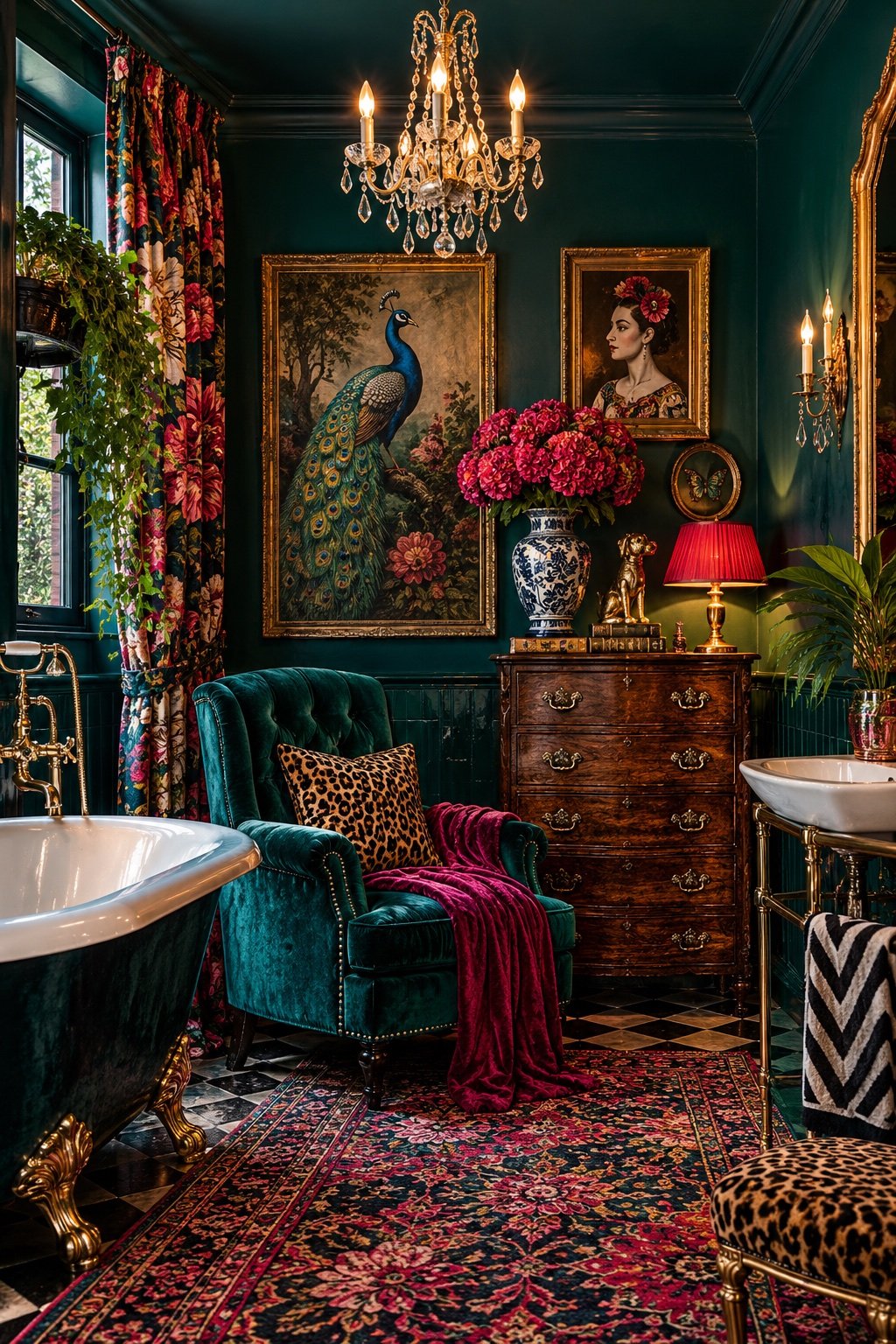
Put an actual piece of furniture in the bathroom. A small carved side chair with a stack of folded towels on it. A dark wood bookcase. A marble-topped washstand used as a shelf. An étagère holding glass bottles, a plaster bust, and a bar of soap nobody is allowed to use.
Of all the Victorian bathroom ideas here, this is the one that separates a decorated room from a styled one. Built-ins read as a renovation; freestanding furniture reads as a room that was furnished. Deliberate chaos, in other words, with a rule: it has to look like it wandered in from elsewhere in the house and stayed.
14. Velvet, Wool, and a Rug That Shouldn’t Be in a Bathroom
Textiles are what most people forget in here, and their absence is why so many bathrooms sound like a swimming pool. A heavy velvet curtain at the window instead of a blind. A worn wool runner on the tile. Waffle-weave towels in oxblood or forest rather than white. A small tapestry, even.
Yes, a rug in a bathroom. A flat-weave vintage-style Persian runner dries fast, hides everything, and looks infinitely better than a bath mat shaped like a kidney. Hang it over the rail to dry if you’re precious about it.
15. Plants That Actually Like Steam and Gloom
The Victorians were fern maniacs, and a dim humid bathroom is the best fern habitat in the house. Maidenhair, bird’s nest fern, a rabbit’s foot fern spilling out of a brass cachepot on top of the cistern. Add pothos, a ZZ plant, or a staghorn mounted on a board if the light is truly grim.
Put them in aged brass, dark glazed ceramic, or a pedestal jardinière — never plastic nursery pots. The container is doing as much aesthetic work as the plant.
Shop the Look
Pieces to start with: black clawfoot tub · encaustic-style floor tile · cross-handle brass faucet · candle wall sconces · ornate mirror · dark floral wallpaper.
More rooms to steal from: gothic bathroom ideas, black bathroom ideas, dark academia bathroom ideas, a Chinese rococo maximalist bathroom.
Building It Without Gutting the Room
If you’re renting or unwilling to touch the plumbing, the order that gets you furthest with Victorian bathroom ideas for the least money is: paint the walls and ceiling dark, swap every light fixture for brass sconces, replace the mirror with something framed and oversized, add art and textiles, and put in a piece of freestanding furniture. Not one of those requires a permit, and together they carry most of the mood.
If you are renovating, spend the money on the floor tile and the tub and let everything else be thrifted. Those two elements are structural to the look; the rest is accumulation, and accumulation is supposed to take years. That’s the difference between a curated obsession and a shopping trip.
Victorian Bathroom FAQ
Do Victorian bathroom ideas work in a small or windowless bathroom?
They work better there than in a large bright bathroom. Dark color erases the corners so the room reads as indeterminate rather than cramped, and the heavy pattern gives the eye enough to do that it stops measuring the square footage. A windowless powder room is the ideal candidate — there’s no daylight to fight, so you control the entire lighting scheme. Just make sure you have real ventilation and at least three warm light sources.
Can wallpaper and framed art survive a bathroom?
With ventilation, yes. Use non-woven or vinyl-coated wallpaper, keep it off the wall immediately adjacent to the shower, and seal the edges and seams properly. For art, use prints and reproductions rather than originals, seal the frame backs, and hang them on the wall furthest from the shower. A working extractor fan or a window that opens does most of the protective work.
What’s the difference between a Victorian and a gothic bathroom?
Victorian is domestic and fussy — florals, encaustic tile, brass, clawfoot tubs, framed botanicals, a bit of fern. Gothic is ecclesiastical and severe — pointed arches, wrought iron, candelabra, stone, oxblood and black with very little pattern. Victorian wants to look like a well-off family lived there for fifty years. Gothic wants to look like a chapel that stopped being used.
How much does a Victorian-style bathroom cost?
The cosmetic version — dark paint, brass sconces, a framed antique mirror, art, textiles, a piece of secondhand furniture — is a few hundred dollars and a weekend. The full version, with patterned floor tile, a reglazed cast-iron clawfoot tub, a console washstand, and new brass fixtures, runs into a real renovation budget. The single best value is paint plus lighting, which changes the room’s entire temperature for under two hundred dollars.
Is dark tile hard to maintain in a bathroom?
Matte dark tile hides soap film and water spots far better than glossy white, though it shows dried mineral deposits in hard-water areas. Dark grout is genuinely lower-maintenance than white, which stains permanently within a year. Seal cement and encaustic tile on installation and reseal annually, and choose honed rather than polished stone so the surface isn’t a mirror every time it gets wet.
Go Ruin a Perfectly Adequate Bathroom
The best thing about Victorian bathroom ideas is the scale of the room. A living room this maximal is a year-long project and a serious amount of money. A bathroom is forty square feet — you can paint it oxblood on a Saturday, hang seven pictures over the tub on Sunday, and by Monday it’s the most interesting room in the house.
People like us don’t have a guest bathroom. We have an installation with a toilet in it.