This post contains affiliate links. As an Amazon Associate, Home Sweet Eclectic earns from qualifying purchases. Read our affiliate disclosure.
A maximalist living room is the room where you stop apologizing. More color, more pattern, more art, more stuff you love, all arranged so it reads as a point of view instead of a pile. The trick is not owning less. It is giving everything a job, a color story and a place to sit.
Below are 15 maximalist living room ideas, each with what to buy, where to put it and how to keep it balanced, plus a section on dodging the clutter trap and a quick FAQ. I’m not a decorator by trade, just someone with a deep love for interiors and zero tolerance for greige. If you want the bigger picture first, start with the full guide to maximalist decor, then come back and get specific.
1. Color-Block With Brights That Shouldn’t Work
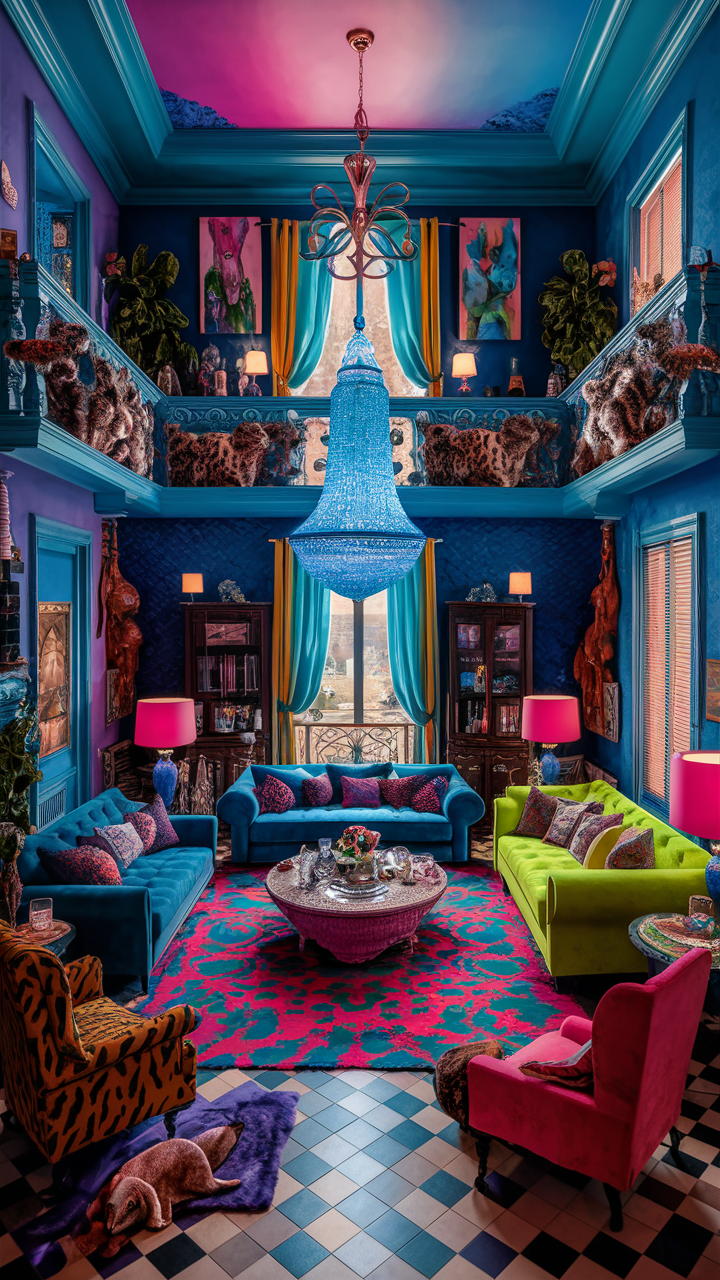
Pick two loud colors from the same side of the wheel, like cobalt and turquoise, then throw in one that crashes the party, like bubblegum pink. Put the two blues on the walls and the pink overhead, where nobody expects it.
How to balance it
Give each big surface one color only. Walls get blue, the ceiling gets pink, and the sofas get their own solids, say lime and electric blue, so the furniture reads as color blocks rather than more noise. Keep the floor quieter, a solid or low-contrast rug, so the eye has one place to rest. A double-height room can take this at full volume. A standard room still can, as long as the blocks stay big and clean.
2. Go Monochrome, Then Turn It All the Way Up
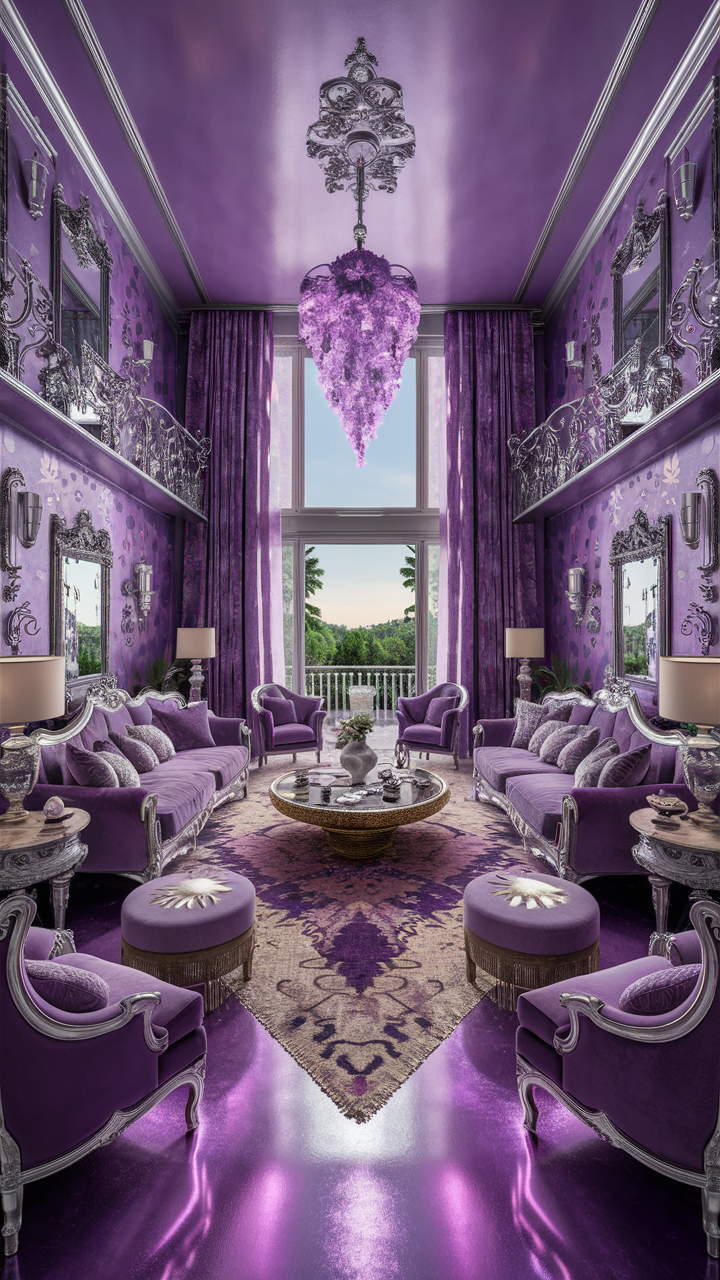
Monochrome is the sneakiest route into a maximalist living room. Choose one color, like violet, and use it everywhere: walls, velvet sofas, curtains, cushions, even the lampshades.
The secret is range. Use at least three shades, from pale lilac to deep grape, and at least three textures: velvet, a glossy painted trim and a nubby bouclé or fringe. Without that variety the room goes flat. With it, the room feels like stepping inside a jewel. A sparkly chandelier stops all that purple from feeling heavy, and one metallic, like brushed brass or chrome, gives it a little wink.
For more on making saturated color feel rich instead of loud, the jewel tone living room ideas post is your next stop.
3. Treat the Ceiling Like a Fifth Wall
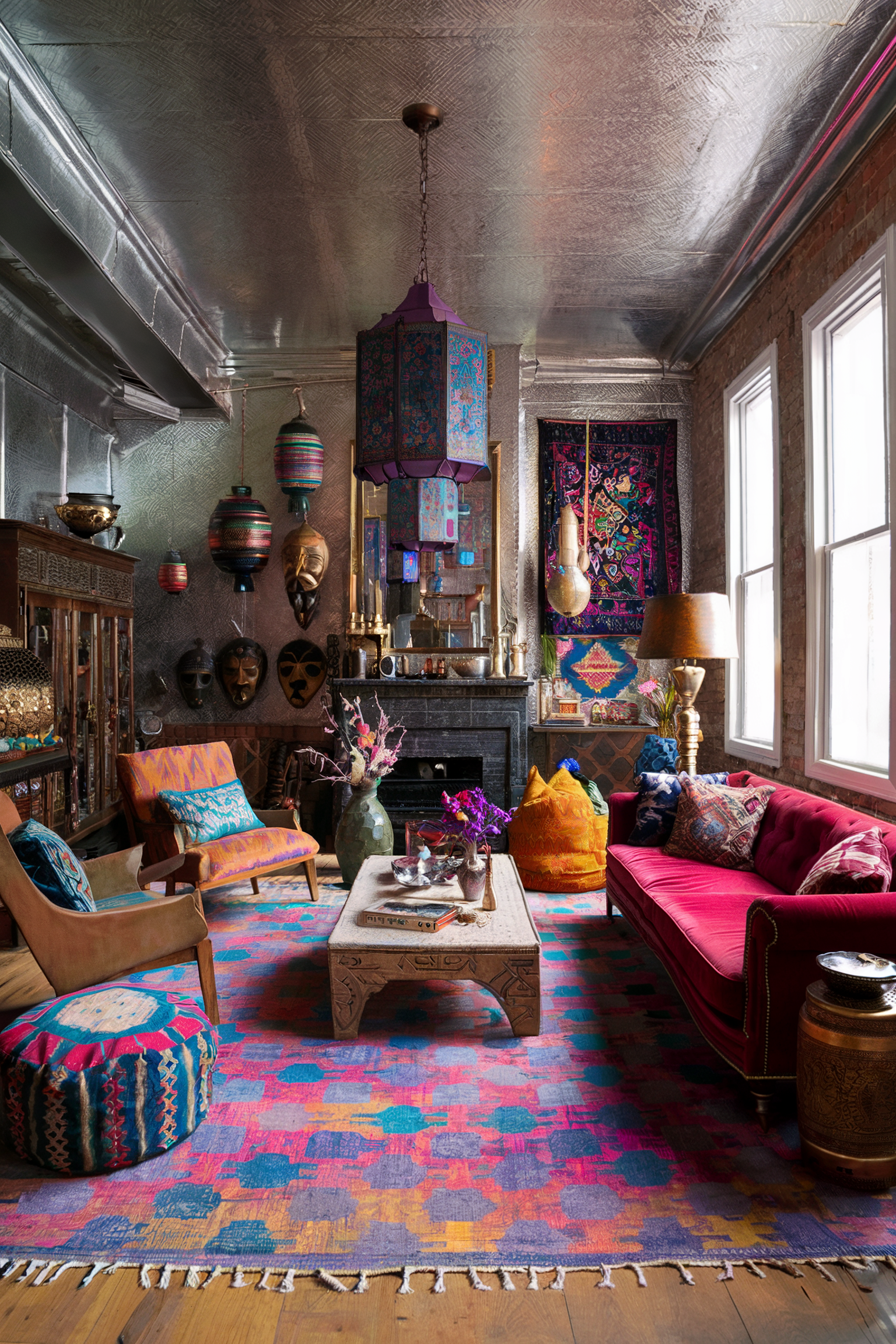
A white ceiling in a maximalist living room is a missed opportunity. Paint it, paper it or go full disco with a metallic finish.
Metallic ceiling how-to
Silver leaf, metallic paint or a foil-effect wallpaper all work. Metallics bounce light around, so they suit rooms that feel dim. Prep matters: any lump or crack in the plaster will show, so skim it smooth first. Once the ceiling shines, ground it with something soft and saturated below, like a pink sofa and a busy patterned rug. Shelves stacked with colorful collections around the edges keep the room feeling personal instead of like a nightclub.
Renting? A peel-and-stick metallic wallpaper gives you the shine with an exit plan.
4. Drench the Paneling in a Saturated Color
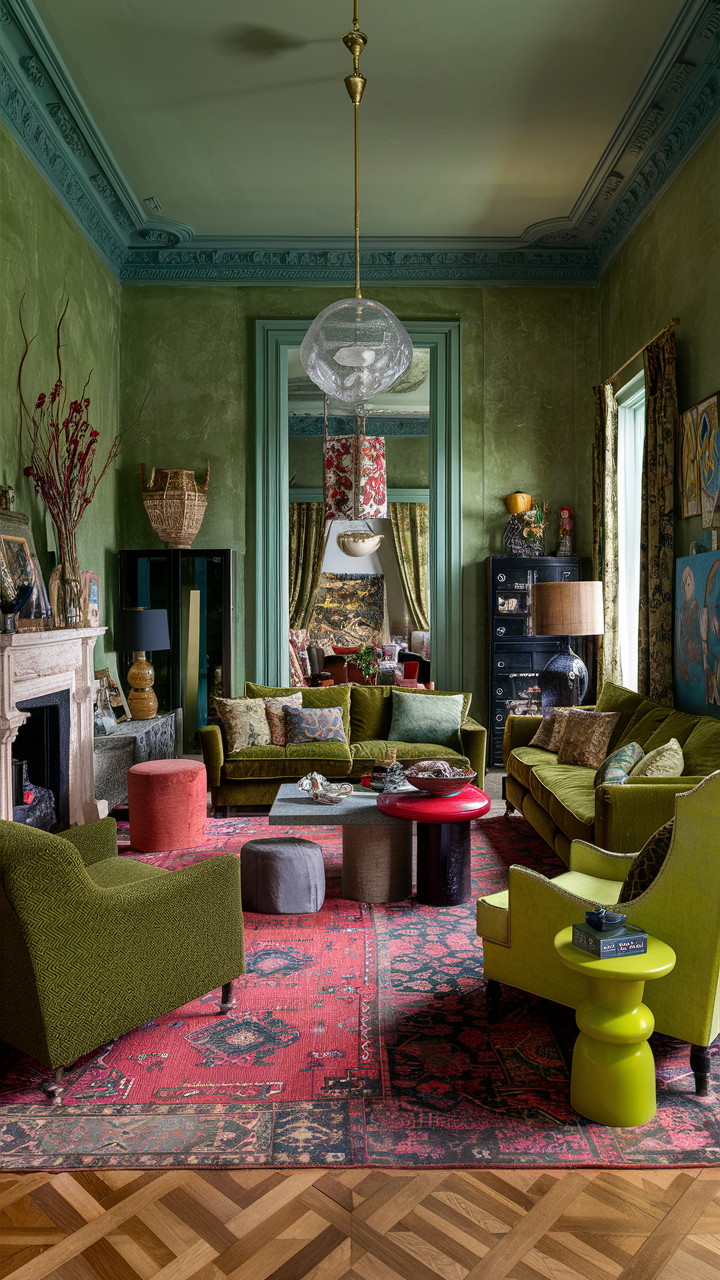
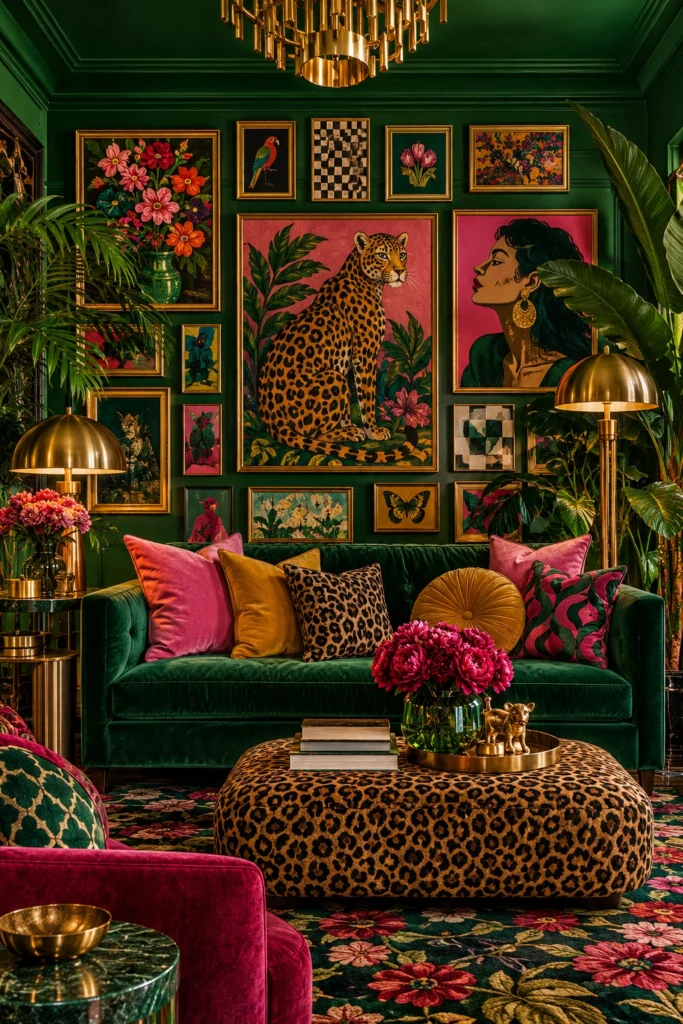
Got wall paneling, wainscoting or even plain molding? Color-drench it. Paint the panels, trim and walls all the same green, in a satin or eggshell finish so the profiles catch the light.
Then add the complementary color in small hits. Green’s opposite is pink, so bring in pink cushions, a pink lamp base and maybe a pink side table. Three to five pink accents scattered around the room is plenty. A patterned rug that holds both colors ties the scheme together. No paneling? Stick-on molding strips and a weekend can fake it.
If green is already your thing, these dark green living room ideas push it further.
5. Hang a Chandelier That’s Slightly Too Big

Lighting is jewelry for the room, and maximalists don’t do dainty. A crystal chandelier over a teal room with blue velvet armchairs feels like a costume party, not a museum.
A rough sizing rule: add the room’s length and width in feet, and that number in inches is a typical chandelier diameter. Then go a few inches bigger. Hang it so the bottom sits at least seven feet off the floor in walkways, lower over a coffee table. Pick something with color or personality, like colored glass drops or a beaded fringe shade, so it feels playful rather than stuffy. Add two or three table lamps so you never rely on the overhead alone.
6. Salon-Hang a Gallery Wall Floor to Ceiling
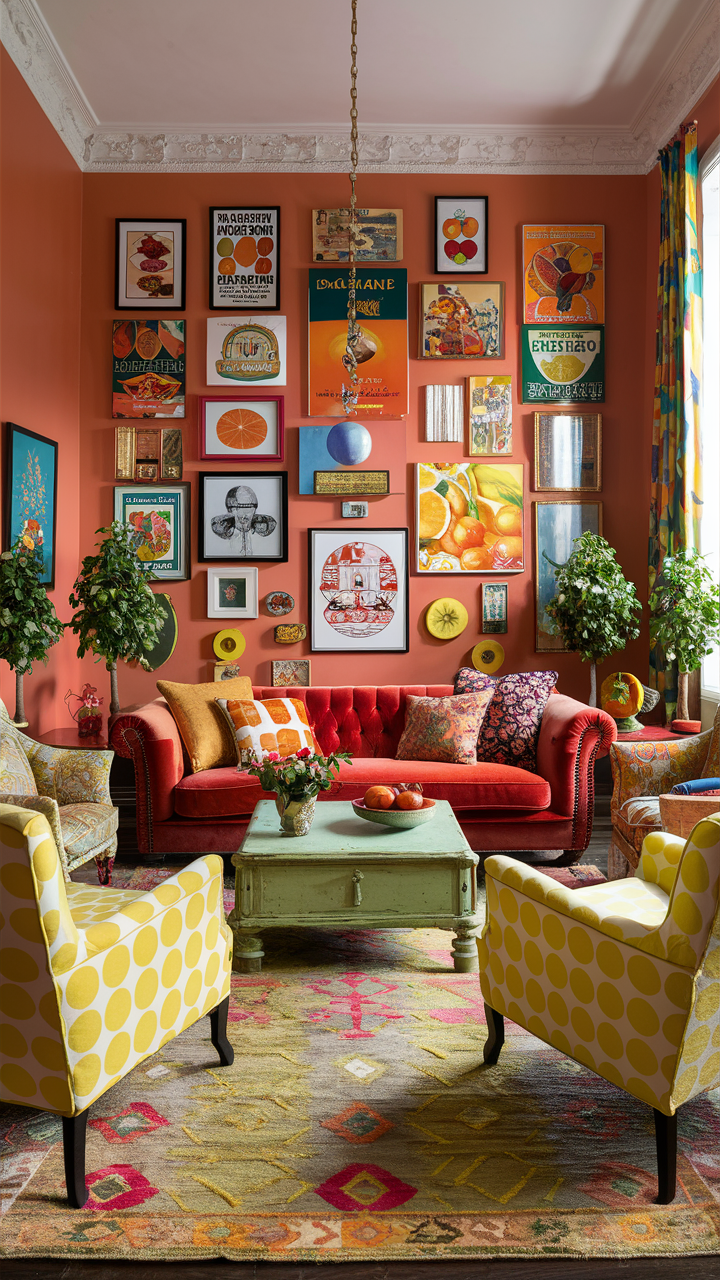
A coral wall packed edge to edge with art, a red sofa below and lime checked armchairs either side: this is what a maximalist living room looks like when it commits.
How to hang it without tears
- Lay everything out on the floor first, or trace frames onto paper and tape them up.
- Start with your biggest piece slightly off-center at eye level and build outward.
- Keep gaps tight and roughly even, about two to three inches.
- Mix frame colors, but repeat each one at least twice so it looks chosen.
A gallery wall frame set gets you started fast, then swap in thrifted frames over time. Want one piece to steal the show? Here are statement pieces and oversized art worth building around.
7. Mix Mirrors Into the Frame Wall
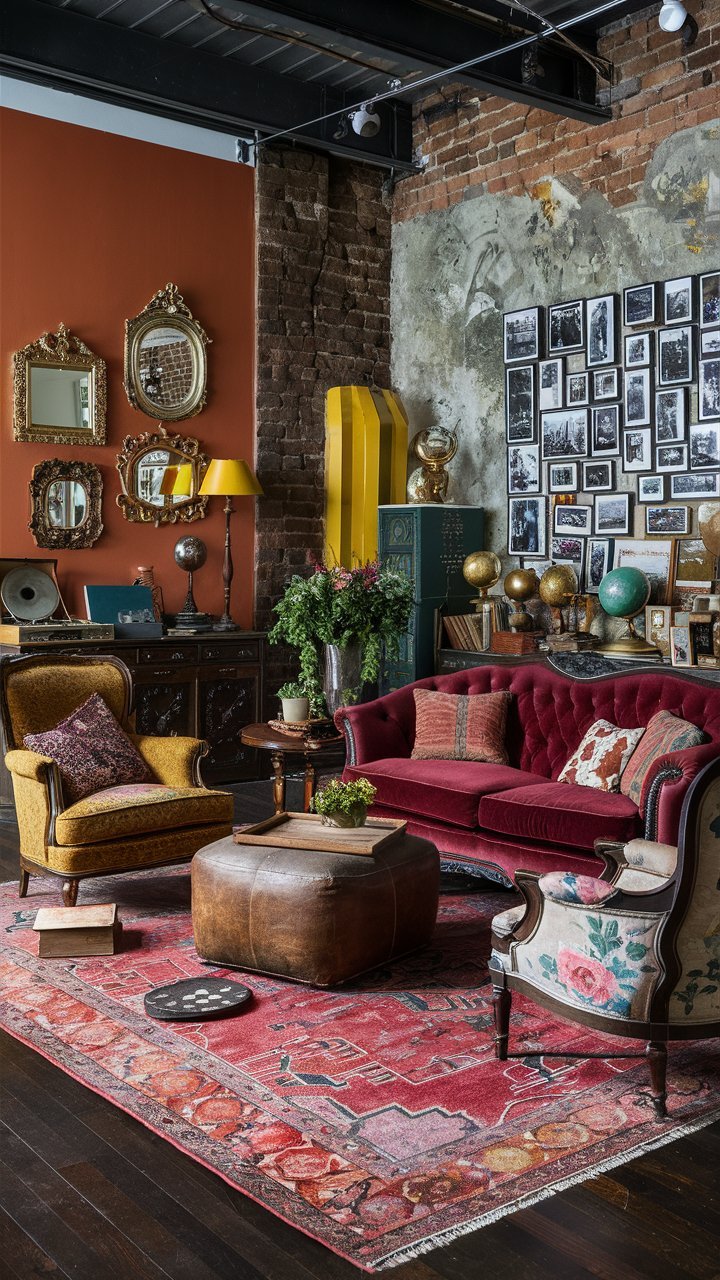
Rust walls, exposed brick and a red sofa already make a hot, earthy room. Add a wall of mismatched mirrors and frames and it starts to glow.
Mirrors break up a wall of art, bounce light and make a busy display feel lighter. Mix shapes: a sunburst, an oval, a scalloped one, something wonky. Put a mirror opposite or next to a window to double the daylight. On brick, use masonry anchors and drill into the mortar, not the brick itself, so it patches easily later. Hunting for the right shapes? This roundup of vintage mirrors is full of ideas.
8. Pair a Classic Sofa With a Jungle of Plants
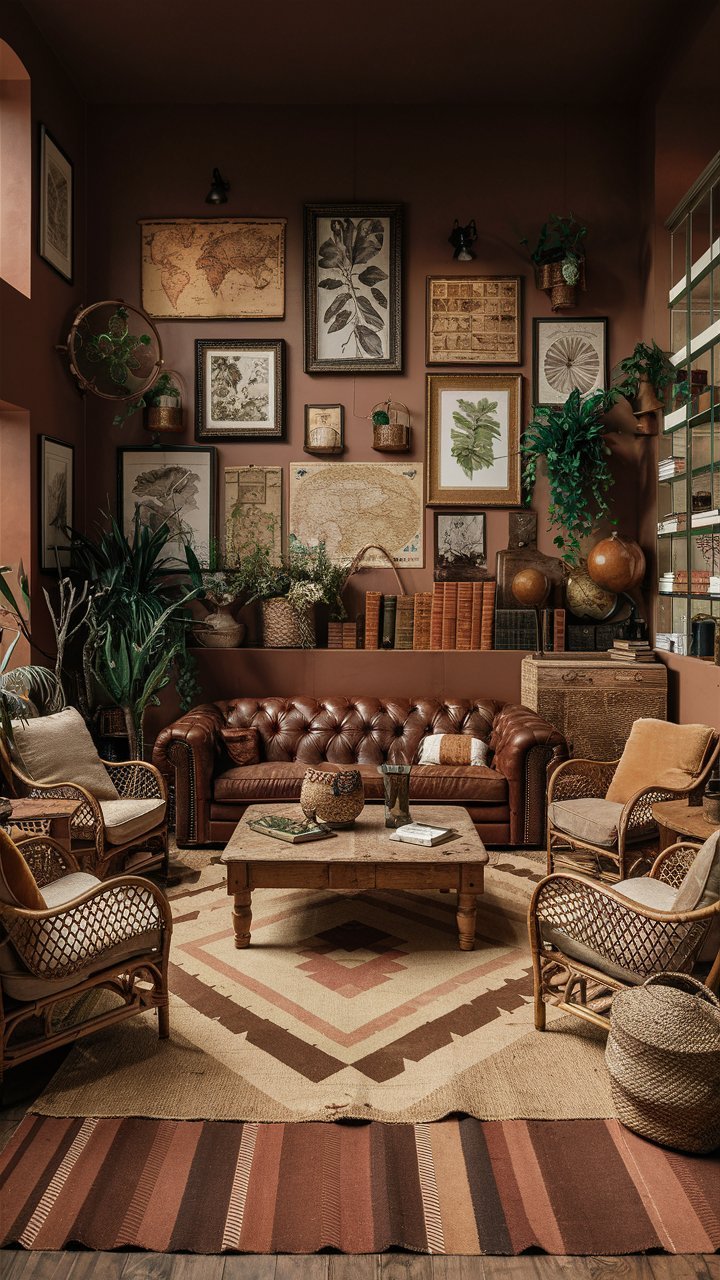
A brown leather chesterfield is the most forgiving sofa for a maximalist room. It goes with everything, it ages well, and it lets the walls do the shouting. Put a big gallery wall above it and surround it with plants.
Go for volume and height variety: one tall floor plant like a fiddle leaf fig or bird of paradise, a couple of mid-height pots on stands, and trailing plants on shelves or hanging from the ceiling. Use mismatched planters in bright glazes so the greenery joins the color story. Brown leather plus lots of green reads lively, not old-fashioned, especially with a clashing kilim cushion or two thrown on.
9. Layer Rugs Like You Mean It
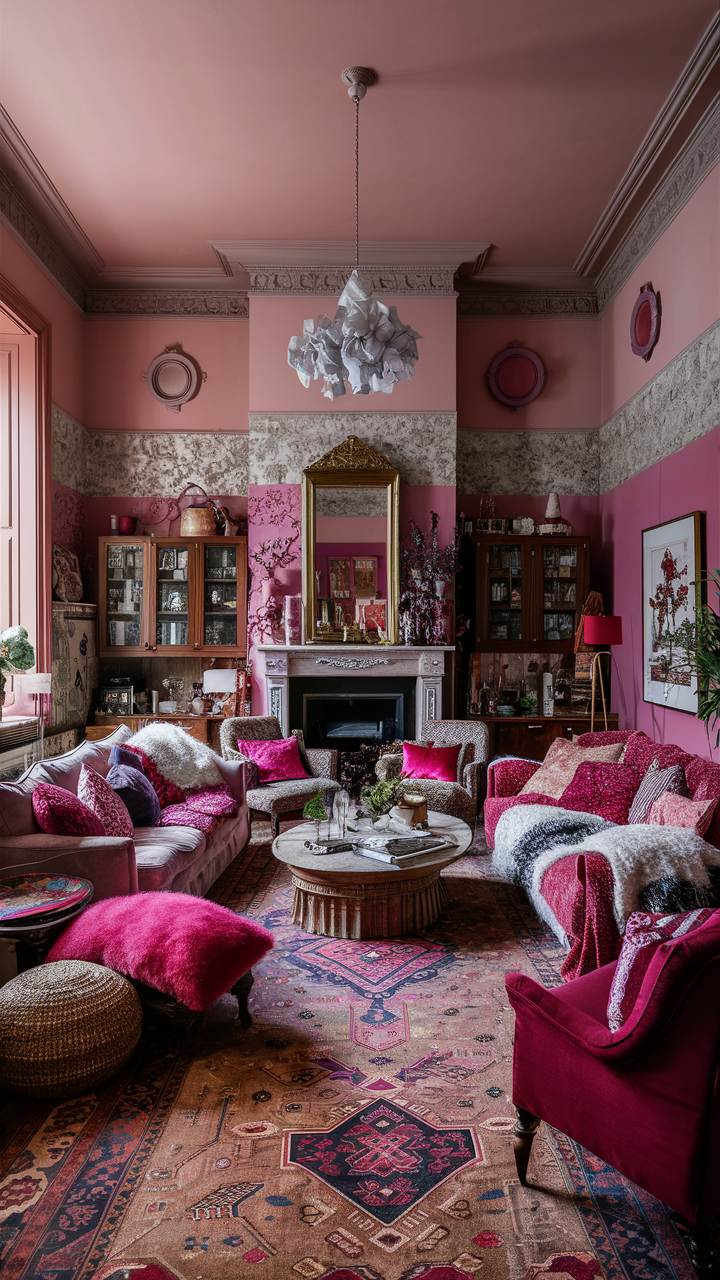
A pink living room with velvet sofas around a fireplace is already cozy. Layered rugs make it feel collected, like you’ve been building it for years.
The layering formula
Start with a large, flat base rug, like jute or a flatweave, big enough that the front legs of every seat sit on it. Then lay a smaller, bolder rug on top at a slight angle, like a vintage-style Persian, a shaggy Moroccan or a hide shape. The base should be calmer than the top layer. A washable vintage-style rug makes a great top layer if you have pets or kids. Use a rug pad underneath so nothing slides.
10. Make the Sofa Sunshine
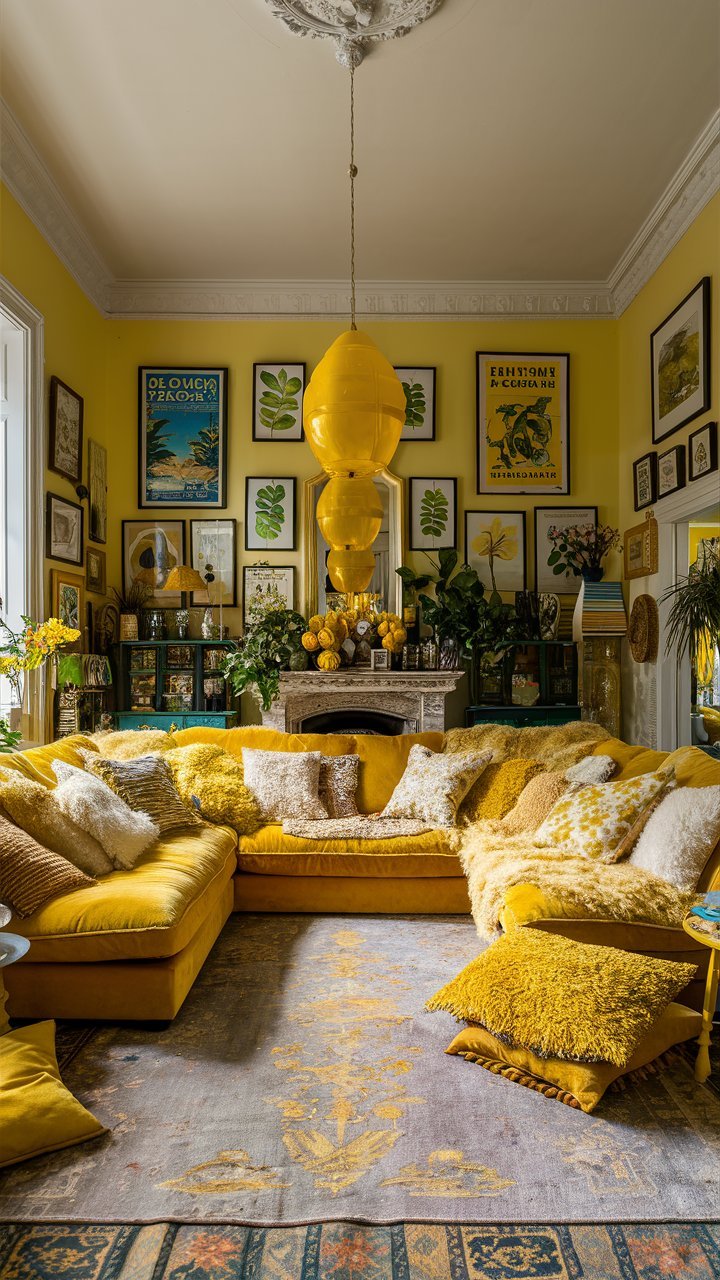
If you buy one big loud piece, make it the sofa. A mustard or sunflower yellow sectional turns the whole room optimistic, and it is easier to live with than you think because yellow goes with blue, pink, green and red.
Back it up with bold graphic posters: gig prints, vintage travel ads, pop art. Frame them big and hang them in a tight row or stacked pair above the sofa. Then repeat the yellow two or three more times around the room, like a lamp, a vase and a stripe in a rug, so the sofa doesn’t feel stranded. Curious why yellow feels so happy? The psychology of color in maximalism breaks it down.
11. Put Pattern on the Sofa and Color on the Windows
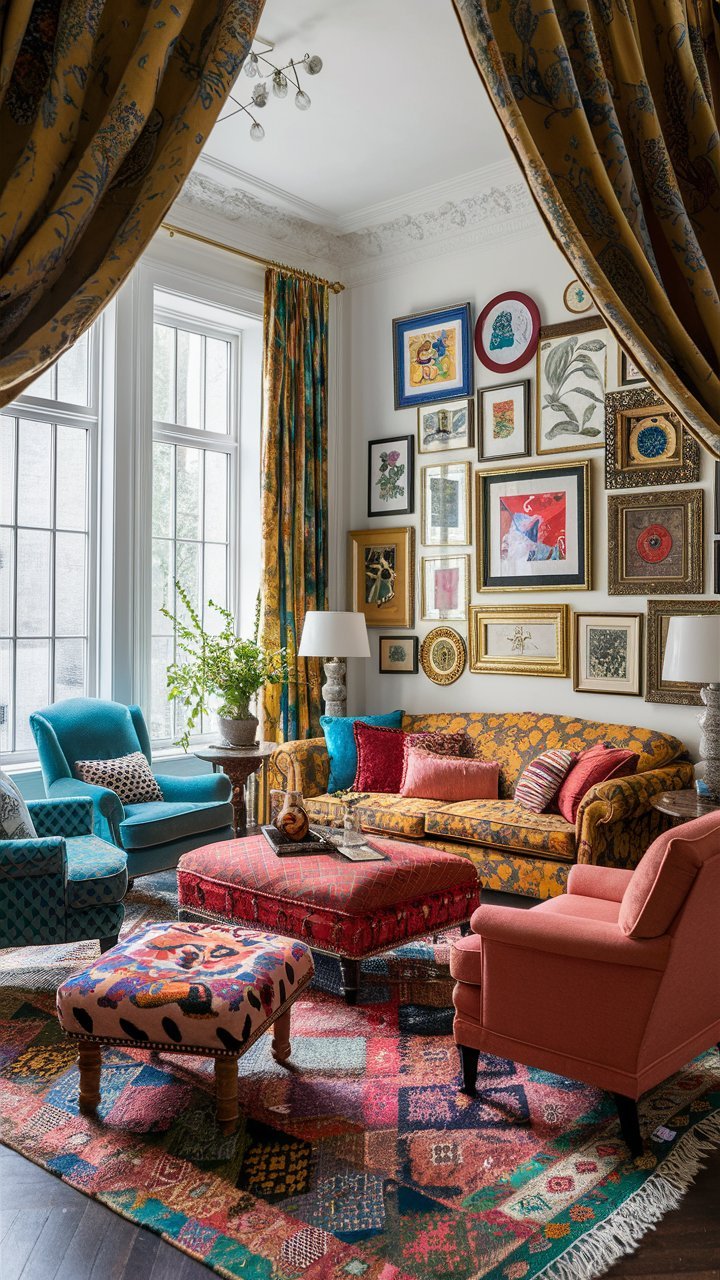
Most people play it safe with a plain sofa and patterned cushions. Flip it. Choose a patterned sofa, florals, ikat or a big graphic, and let it be the main event.
Then hang floor-to-ceiling drapes in a bold solid, like tangerine. Mount the rod high, close to the ceiling, and a hand-width or more past each side of the window so the curtains frame the glass instead of covering it. Velvet curtains add depth and soak up sound in a busy room. Pull one color from the sofa fabric for the drapes and the whole wall clicks together, even with a gallery wall next to it.
12. Clash Patterns, But Give Them a Common Thread
Pattern clash is the heart of an eclectic maximalist living room. Stripes next to florals next to checks can look amazing, as long as something ties them together.
Use three rules. Vary the scale: one large, one medium, one small pattern in any grouping. Share a color: every pattern should hold at least one hue from your main palette. Repeat: use each pattern at least twice in the room. Start with cushions, the cheapest test lab you’ll find. A pile of patterned velvet pillow covers lets you try combinations before you commit to upholstery. For the full method, read how to mix patterns.
13. Wallpaper the Wall Nobody Looks At
Everyone papers the wall behind the sofa. Try the other spots: inside built-in bookshelves, the alcoves either side of a fireplace, a chimney breast, or the ceiling.
Big-scale prints, like tropical leaves, oversized florals or wild animal patterns, actually make small areas feel bigger because they read as one bold gesture. Paper the backs of shelves and your books and objects pop forward like a display case. For a groovy touch, pick a 1970s-style geometric in orange and brown, or a wavy psychedelic stripe.
14. Bring In Curves and Groovy Shapes
A room full of rectangles feels stiff no matter how colorful it is. Add curves: a round coffee table, a scalloped-edge armchair, a mushroom lamp, a squiggle mirror, an arched bookcase.
Aim for at least three curvy pieces at different heights, like a low pouf, a mid-height side table and a tall arc floor lamp. Curvy furniture also helps traffic flow because there are no sharp corners to bump into. Glossy lacquer, colored acrylic and tufted velvet keep the shapes feeling fun rather than formal.
15. Display Collections in Groups, Not Scattered
Your collection of ceramic cats, vintage glass or tiny souvenir buildings is the soul of your room. Scattered alone, though, they look like clutter. Grouped, they look like a story.
Gather like with like on one shelf, tray or cabinet. Group by color for a rainbow effect, or by type for a museum moment. Odd numbers, three, five or seven, look natural. Vary heights with books or small stands as risers. A glass-front cabinet keeps dust off and turns the whole thing into a feature. Rotate pieces every season so the display stays fresh. This mix of old, new and personal is what eclectic decor is all about.
How to Keep a Maximalist Living Room From Feeling Cluttered
Maximalism is abundance with intention. Clutter is abundance with no plan. Here is how to stay on the right side of the line.
- Pick a palette of three to five colors. Everything you bring in should hold at least one of them. That single rule does most of the work.
- Give the eye a resting spot. One calmer zone, like a solid sofa, a plain rug or a single bare wall, makes the busy parts look deliberate.
- Clear the floor and the walkways. Go as wild as you like on walls and ceilings, but keep paths at least three feet wide and floors mostly clear.
- Hide the boring stuff. Remotes, chargers, mail and cables go in lidded boxes, baskets or a closed cabinet. Display is for things you love, not things you use daily.
- Edit seasonally. Twice a year, take everything off one shelf and only put back what still makes you smile.
- Group, don’t sprinkle. Clusters read as collections. Single objects dotted everywhere read as mess.
Maximalist Living Room FAQ
What is a maximalist living room?
It is a living room built on more: bold color, layered pattern, lots of art and personal collections, arranged with intention. The goal is a room that feels rich, personal and joyful rather than sparse.
Can a small living room be maximalist?
Yes. Small rooms often look better maximalist because bold color and big-scale pattern blur the edges of the space. Use a strong wall color, one big gallery wall and plenty of mirrors, and keep the floor as clear as you can.
How do you make a maximalist living room feel cozy instead of chaotic?
Stick to a limited color palette, lean on soft textures like velvet and wool, layer warm lamp light at different heights, and repeat colors and patterns so everything feels connected.
Is maximalist living room decor expensive?
Not necessarily. Paint, thrifted frames, secondhand furniture, flea-market finds and new cushion covers do most of the heavy lifting. Maximalism rewards patience more than budget, since the best rooms are built slowly.
What is the difference between maximalist and eclectic?
Maximalism is about volume and boldness. Eclectic is about mixing styles and eras. An eclectic maximalist living room does both: lots of color and pattern, pulled from different decades and places.
Start with one idea from this list, a painted ceiling, a gallery wall or a stack of clashing cushions, and build from there. The best maximalist living rooms aren’t finished in a weekend. They grow, one beloved thing at a time, until the room looks like nobody else could live there but you.