This post contains affiliate links. As an Amazon Associate, Home Sweet Eclectic earns from qualifying purchases. Read our affiliate disclosure.
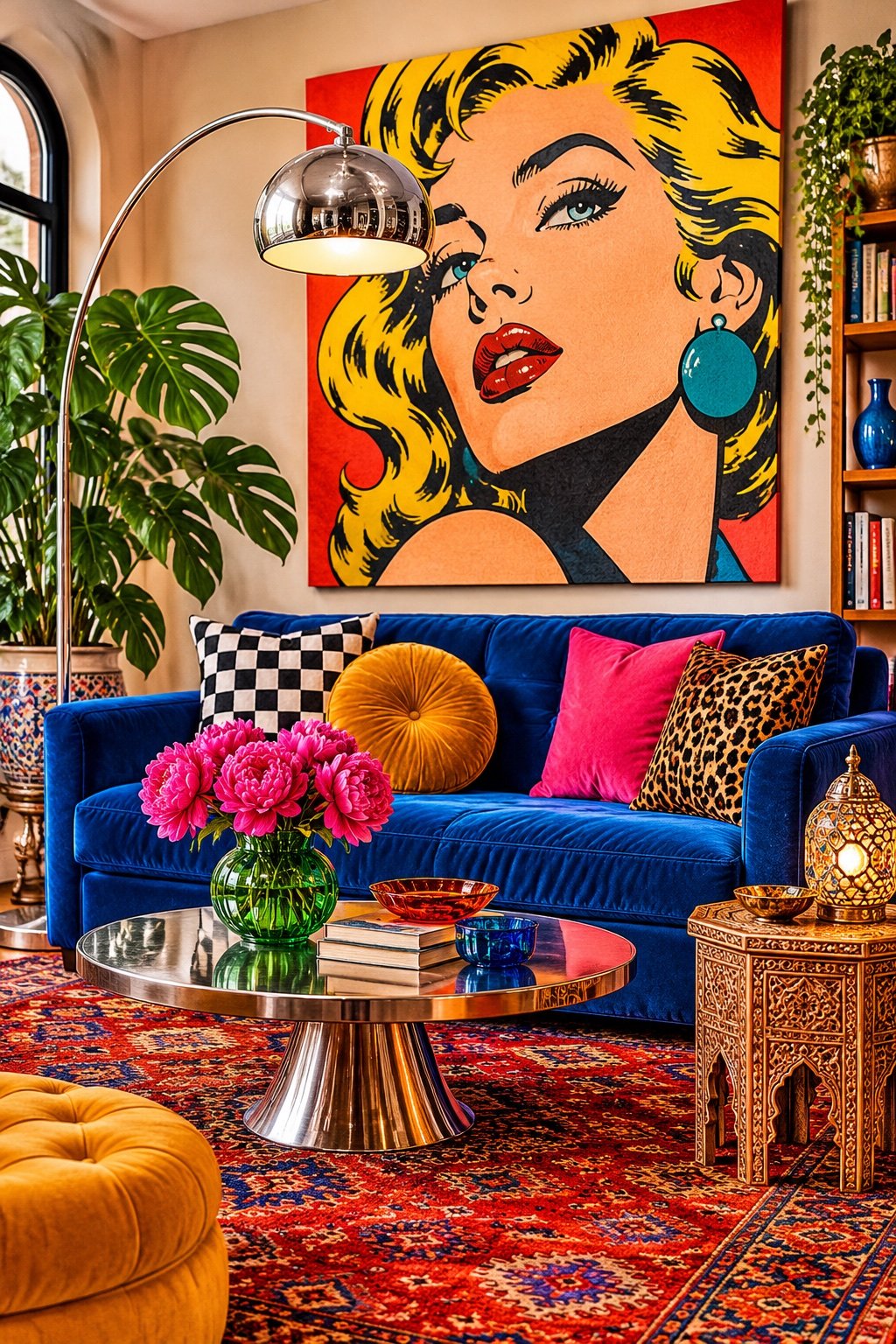
Eclectic decor is the art of mixing furniture, objects and patterns from different eras, cultures and styles in one room, and making the whole thing look intentional. A 1970s chrome lamp next to a carved Moroccan side table under a pop-art print? That can be eclectic. It can also be a yard sale. The difference is a handful of quiet rules working underneath the noise.
This guide gives you those rules. You’ll get the real eclectic decor meaning, the threads that hold a mixed room together, how to blend vintage with modern and global with retro, how to edit without draining the fun, and how eclectic stacks up against maximalist and boho. Then we go room by room, and finish with where to hunt for the good secondhand stuff.
Fair warning: this is a guide for people who want more color, not less. Nobody here is going to tell you to “start with a neutral base.”
What Eclectic Decor Actually Means (and Why It Isn’t “Random”)
The word comes from the Greek for “selecting.” That’s the whole point. An eclectic room is selected. Every piece earned its spot because it relates to something else in the room, even if that relationship is sneaky.
A random room is what happens when you buy things one at a time with no plan and then put them wherever they fit. Nothing talks to anything. Your eye bounces around looking for somewhere to land and finds nothing, so the room reads as clutter, not personality.
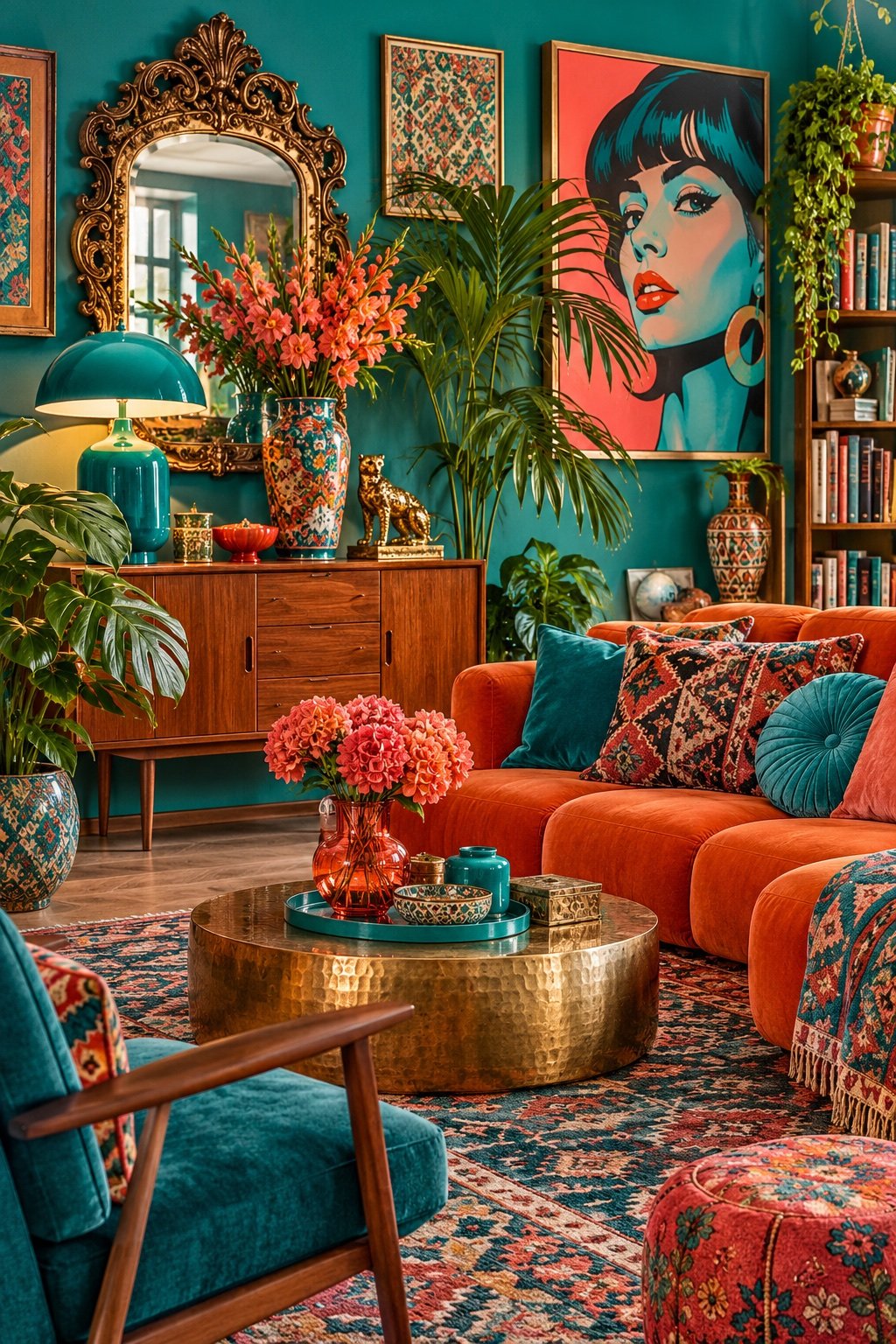
An eclectic room has the same variety, but your eye travels. It catches the tomato red on a vintage rug, then finds that red again in a lampshade, then again in the spine of a book on the shelf. The pieces come from forty different places, but they’re having one conversation.
The Four Threads That Hold an Eclectic Room Together
Think of these as the invisible stitching. You don’t need all four in every room, but you need at least two pulling hard, and the more styles you mix, the more threads you’ll want.
1. Repeated Color
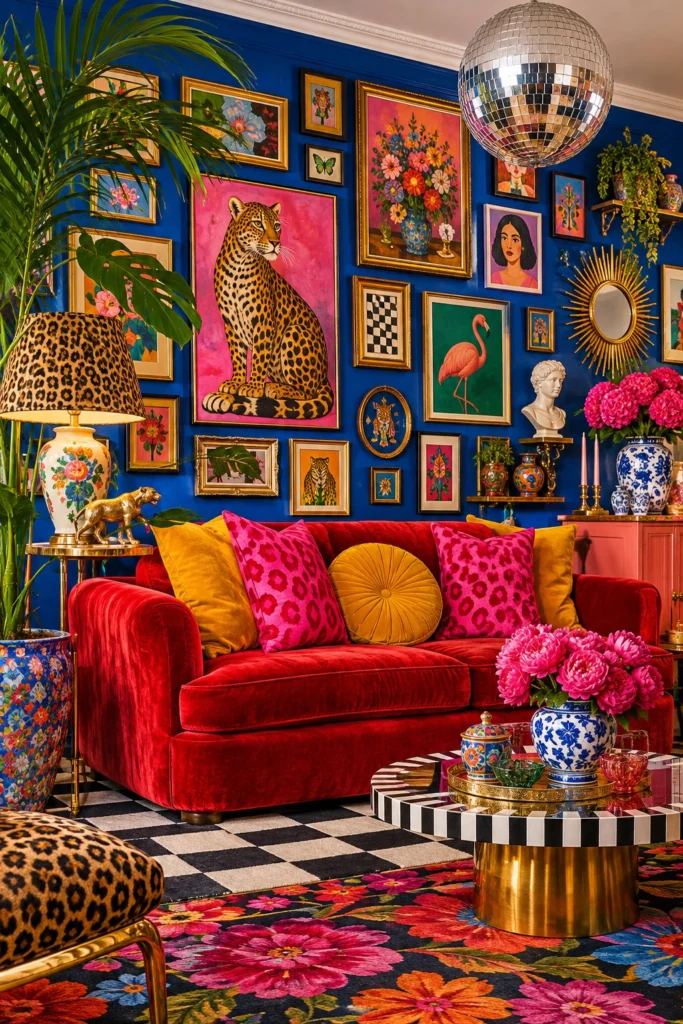
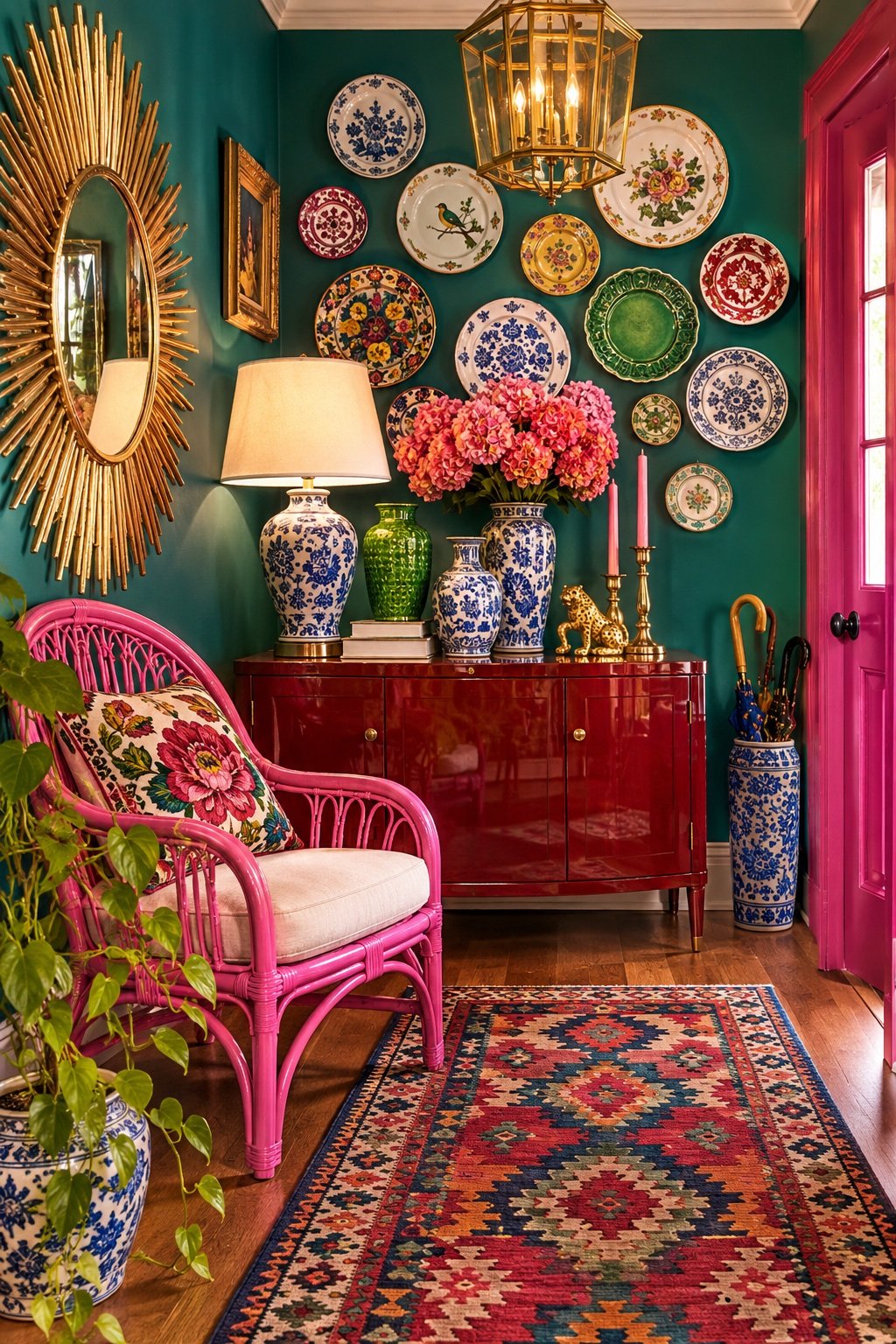
This is the strongest glue you have. Pick two or three colors and repeat each one at least three times around the room, at different heights. A cobalt sofa, a cobalt vase on the mantel, a cobalt stripe in the curtains. Suddenly a Danish chair and a Victorian settee look like they’re on the same team.
The repeats don’t have to match exactly. Cobalt, navy and electric blue all count as “blue” to the eye, and the slight variation actually looks richer than a perfect match. If you want to go deeper on how hues work together, our piece on the psychology of color in eclectic maximalism breaks down why certain combinations feel energizing and others feel heavy.
Before you commit to a wall color, paint big swatches and live with them for a week. A pack of peel-and-stick paint sample sheets lets you move a color next to your rug, your sofa and your art without repainting anything.
2. A Consistent Finish
Finish means the surface quality: the metal tone, the wood tone, the sheen. If every piece of hardware in the room is brass, you can mix a mid-century credenza, a 1980s lacquered tray table and a bamboo bar cart and they’ll still feel related. Same if all your wood skews warm and reddish, or if everything has a high-gloss lacquer moment.
One trick: swap the knobs. Changing the pulls on three mismatched dressers to the same colorful ceramic drawer knobs ties them together in an afternoon, and it’s cheap enough to undo.
3. Scale
Mixed rooms fall apart when everything is the same size. Ten medium things in a row look like a showroom. Instead, give the room one or two big pieces, a few medium ones and a scattering of small ones. Oversized art, a giant floor plant or a towering bookshelf creates an anchor that everything smaller can orbit around.
4. A Focal Point
Every eclectic room needs a boss. One thing that is unmistakably the star: a wild wallpapered wall, a fireplace, a huge thrifted painting, a velvet sofa in a color that shouldn’t work. The boss tells the eye where to start. Everything else becomes the supporting cast.
No focal point, and every object competes for attention. That’s the exact moment eclectic tips into random.
Mixing Eras and Styles Without Losing the Plot
This is the fun part. Here’s how to blend wildly different sources so they flatter each other.
Vintage Plus Modern
The easiest eclectic pairing, and a great place to start. Put a clean-lined modern sofa under a loud, ornate thrift-store frame holding something irreverent, like a neon print or a kid’s painting. Pair a carved antique dining table with molded acrylic chairs. The contrast makes both pieces look more like themselves.
Keep the ratio uneven. Something like 70/30 or 80/20 reads as a confident choice, while a 50/50 split can look like two people who couldn’t agree. Decide which era is the majority and let the other one be the plot twist.
Global Plus Retro
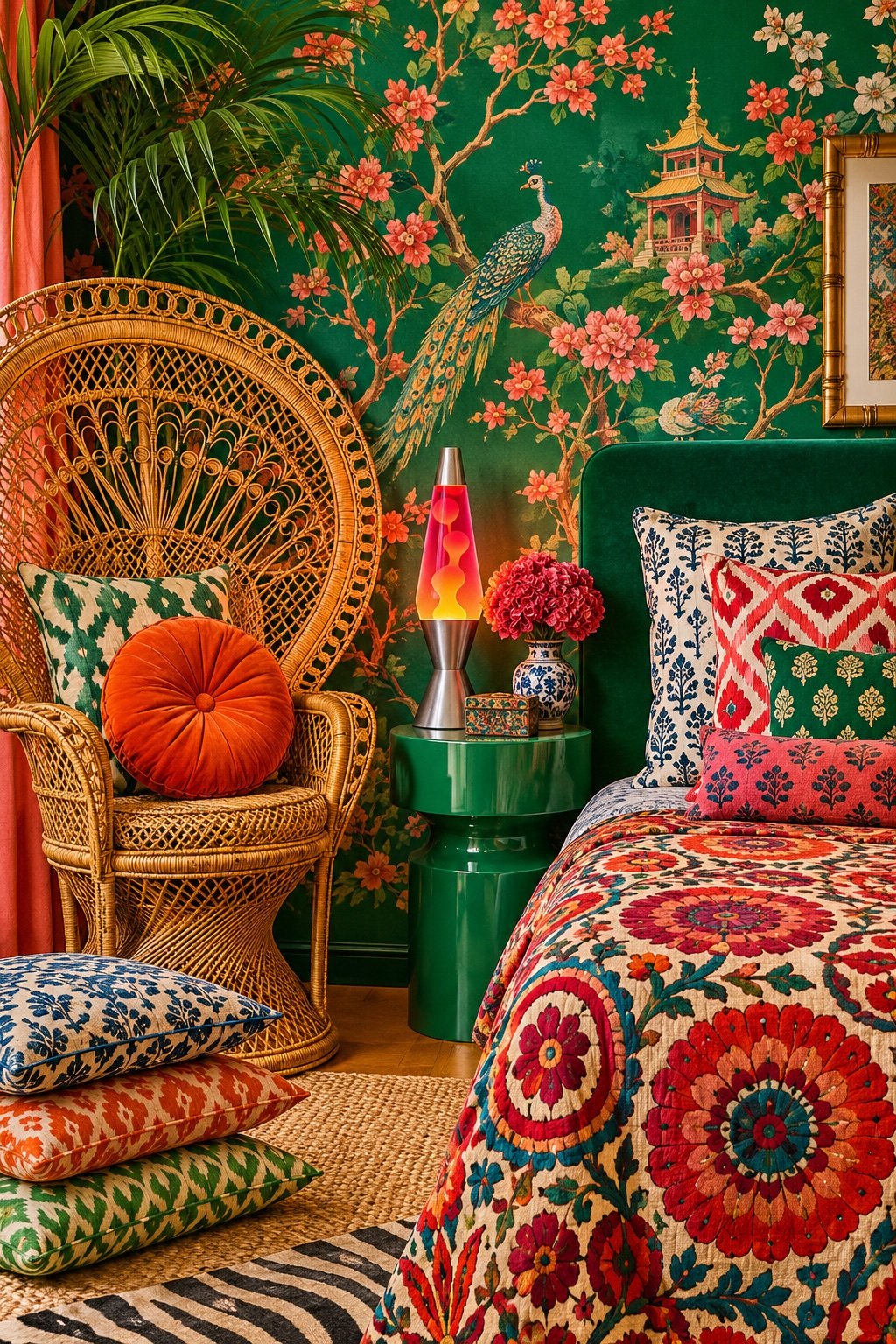
Global textiles and retro furniture get along beautifully because both love bold pattern and saturated color. A suzani throw on a 1960s chrome-and-leather lounger. Indian block-print curtains framing a 70s rattan peacock chair. Chinoiserie wallpaper behind a lava lamp. It sounds unhinged and looks fantastic.
For a masterclass in this kind of pairing, see how we mixed opposites in Hollywood Regency meets Japanese Zen bedrooms, and the sun-drenched blend in our Chinese and Mediterranean mashup bedrooms. Both show how a shared palette lets two very different traditions sit side by side.
The Bridge Piece
When two styles feel too far apart, add something that belongs a little to both. A rattan chair works in boho and in mid-century. A brass lamp fits Art Deco and Hollywood Regency. A kilim pillow bridges global and farmhouse. One well-chosen bridge piece can stop a pairing from looking like an accident.
Pattern Clash, On Purpose
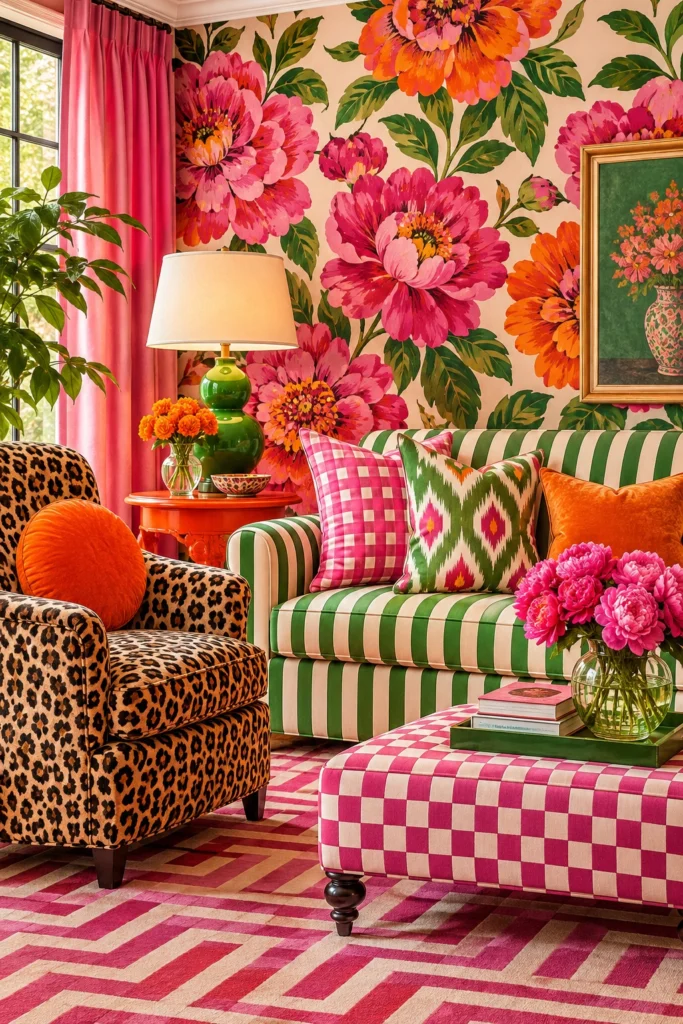
Clashing patterns are allowed, encouraged even. Make it work by varying scale: one large pattern (a big floral wallpaper), one medium (a geometric rug), one small (a tight check on a cushion). Then make sure at least one color runs through all three. Big, medium, small, plus a shared color, and you can stack stripes on florals on leopard and get away with it.
How to Curate and Edit Like You Mean It
Editing isn’t about having less. It’s about making sure everything you have is pulling its weight. Here’s a process that works.
- Empty one surface completely. Clear a shelf, a mantel or a sideboard. Put back only the pieces you actively love, one at a time, and stop when it starts to feel crowded rather than full.
- Group in odd numbers. Three or five objects read as a vignette. Two or four tend to look like a pair and its leftovers.
- Cluster by color. Bring together all your green objects from around the house and display them on one shelf. A jumble of random green things suddenly looks like a collection.
- Rotate, don’t hoard. Keep a “resting” box. Swap pieces in and out every season. The room stays fresh and your favorite things never become wallpaper.
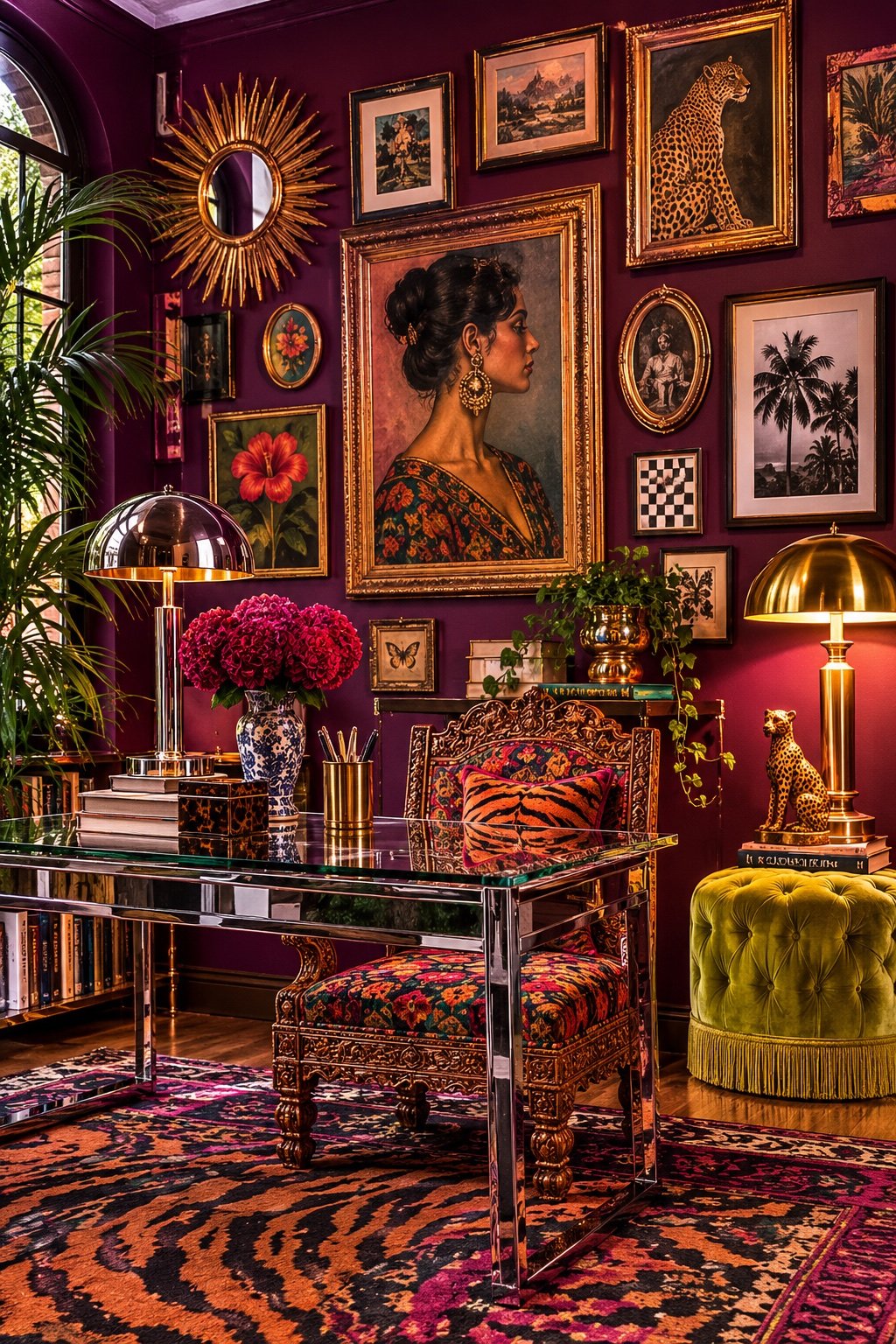
Hanging art is where a lot of eclectic rooms either sing or wobble. A gallery wall of mismatched frames needs a consistent gap between pieces, roughly two to three inches, to look curated. A decent picture hanging kit with a level makes that so much less painful.
Eclectic vs Maximalist vs Boho: What’s the Difference?
These three get lumped together constantly. They overlap, but they’re not the same thing.
- Eclectic is about mixing. Different eras, styles and cultures in one space, tied together by shared threads. An eclectic room can be fairly spare, as long as the pieces come from different worlds.
- Maximalist is about volume. More color, more pattern, more objects, more layers. A maximalist room could technically stick to one style, like a full-throttle Victorian parlor, and still count.
- Boho is a specific look: natural fibers, macramé, rattan, plants, global textiles, warm earthy tones and a relaxed, traveled feeling. It’s often eclectic in spirit, but it has a recognizable uniform.
So, eclectic vs maximalist? Eclectic is how you choose. Maximalist is how much you choose. Put them together and you get eclectic maximalism, which, not coincidentally, is what this entire site is about: lots of stuff, from lots of places, turned all the way up.
Boho can be a wonderful ingredient inside a bigger eclectic scheme. For proof, look at our boho meets industrial bedrooms, where soft macramé and plants run straight into steel and exposed brick.
Eclectic Decorating Ideas, Room by Room
Living Room
Start with the focal point and build out. Choose one statement piece, like a curved sofa in a saturated color or a dramatic wallpapered wall, then layer in a vintage rug, at least one piece of furniture from a different decade and a mix of lamp styles. Lighting is a great place to mix eras because lamps are small enough to swap easily.
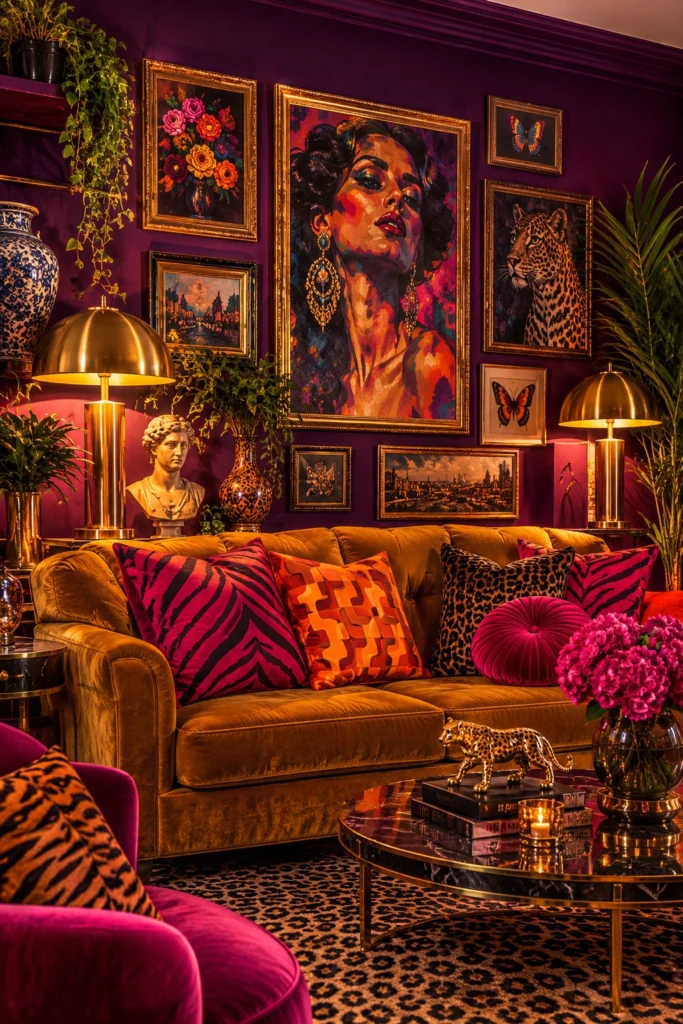
Dark walls are a gift here. They make mismatched pieces glow and soften the transitions between styles. Our roundup of dark moody eclectic living rooms shows how deep color pulls a crowd of objects into one mood.
Dining Room
Mismatched chairs are the classic eclectic dining move, and they work best when one thing stays consistent: the same paint color, the same seat fabric, or the same wood tone. Or go the other way and keep the chairs identical but make the table, pendant and sideboard come from three different eras.
A big vintage mirror over the sideboard bounces candlelight around and adds an instant sense of history. Hunt for frames with real character, the way we did in our list of unique vintage mirrors. And for a whole feast of ideas, our eclectic maximalist dining rooms are dinner-party ready.
Bedroom
The bedroom is where you can be most personal, because guests rarely see it. Let the bed be the boss with a headboard that has a strong silhouette, then mix bedding patterns using the big-medium-small rule. Nightstands don’t need to match. In fact, two different vintage nightstands at roughly the same height look more eclectic than a matched set.
Home Office
Offices tend to slide into beige practicality. Fight it. Pair a modern ergonomic chair with a vintage desk, line the shelves with books organized by color, and hang art you actually want to stare at between calls. Our eclectic maximalist home offices prove that a workspace can be functional and wildly fun.
Kitchen and Bathroom
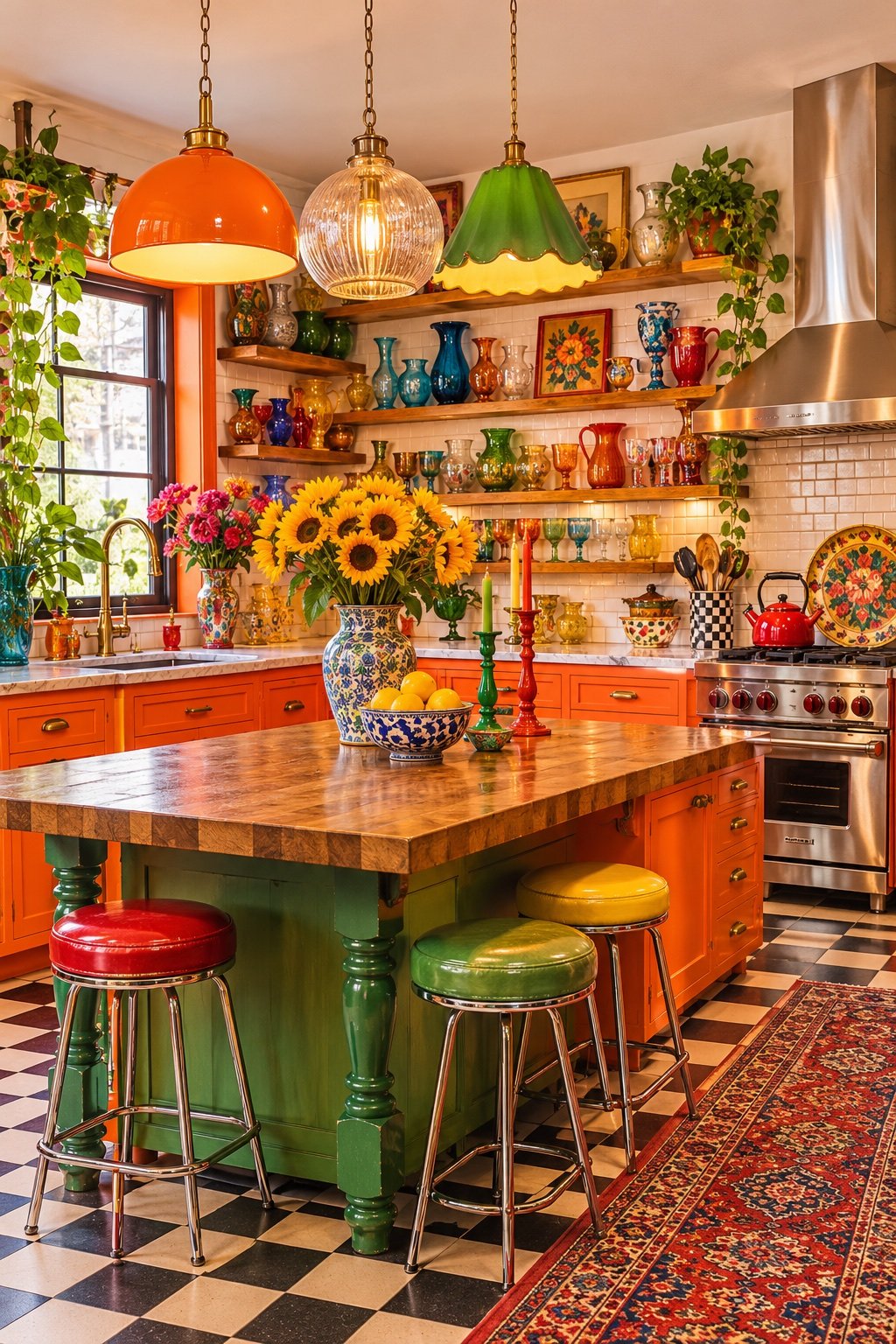
These rooms have a lot of fixed surfaces, so the eclectic layer comes from what you can change. In the kitchen: vintage glassware on open shelves, a thrifted rug, a mix of pendant styles, and art leaned against the backsplash. In the bathroom: a bold wallpaper, a carved or lacquered mirror, mismatched vintage towels and a small gallery of framed prints that can handle a little humidity.
Sourcing Secondhand and Vintage Finds
Eclectic rooms are built over time, and secondhand shopping is the engine. New stores sell coordinated collections. Thrift stores sell stories.
Where to Look
- Thrift stores and charity shops: best for frames, lamps, glassware, small side tables and art. Go often, because stock turns over fast.
- Estate sales: fantastic for whole-era finds, like a complete 1960s bar set or a stack of old botanical prints. Go early for the big pieces, late for the discounts.
- Flea markets and antique malls: great for global textiles, brass, ceramics and oddities. Bring cash and be ready to haggle politely.
- Online marketplaces: use search terms like “vintage,” “retro,” “MCM,” “rattan,” or “estate,” and set saved searches so new listings come to you.
What to Look For
Buy for shape first, color second. Paint, new upholstery and new hardware can fix almost any color, but they can’t fix a dull silhouette. A chair with a wild curved back in an ugly brown is a better buy than a boring chair in a perfect shade.
Check solid wood furniture for wobbly joints, and sniff upholstered pieces before you carry them home. Lamps can be rewired, frames can be painted, and chipped ceramics can sit chipped side to the wall. A little wear is part of the charm.
Finally, buy what makes you laugh or gasp. Eclectic decor is personal. The weird ceramic cat, the souvenir plate from a town you’ve never visited, the painting of a stranger in a feathered hat: these are the pieces that make a room yours instead of a catalog page.
Eclectic Decor FAQ
What is the meaning of eclectic decor?
Eclectic decor means combining furniture, art and objects from different periods, styles and cultures in one space, unified by shared elements like repeated color, consistent finishes, varied scale and a clear focal point.
How do I make eclectic decor look intentional, not messy?
Repeat two or three colors at least three times each, keep one finish consistent, mix big and small pieces, and give every room one obvious focal point. Then edit surfaces so each object has breathing room.
Is eclectic the same as maximalist?
No. Eclectic is about mixing styles, while maximalist is about abundance. A room can be eclectic and fairly restrained, or maximalist and single-style. Combine them and you get eclectic maximalism.
How many styles can I mix in one room?
There’s no hard limit, but most rooms feel strongest with one dominant style and two or three accent styles. The more you mix, the more you need repeated color and a consistent finish to hold it together.
Can I do eclectic decor on a budget?
Absolutely. Eclectic is one of the most budget-friendly styles because it thrives on thrifted, inherited and curbside finds. Paint, new knobs and fresh lampshades transform secondhand pieces for very little money.
Eclectic decor isn’t about following a style. It’s about building one, piece by piece, out of everything you love. Pick your colors, choose your boss, mix your eras with a wink, and keep hunting. The room will never be finished, and that’s exactly the point.