This post contains affiliate links. As an Amazon Associate, Home Sweet Eclectic earns from qualifying purchases. Read our affiliate disclosure.
Pinterest searches for dark cottagecore kitchen ideas are up 915% — and honestly, we saw this coming. The light-and-airy cottagecore moment had its run. Now the pendulum has swung somewhere far more interesting: into the shadows, into the overgrown garden at dusk, into kitchens that feel like they belong to a hedge witch with impeccable taste.
At Home Sweet Eclectic, dark cottagecore is our native language. It’s cottagecore stripped of the pastel sweetness and dressed instead in forest green, burgundy, and charcoal — layered with antique finds, trailing botanicals, mismatched pottery, and candlelight that makes everything look like a seventeenth-century still life. It’s maximalist. It’s moody. It’s deeply, unapologetically eclectic.
Here are 13 dark cottagecore kitchen ideas to get you started — from full renos to renter-friendly switches you can do this weekend.
1. Go Full Forest Green on Your Cabinets
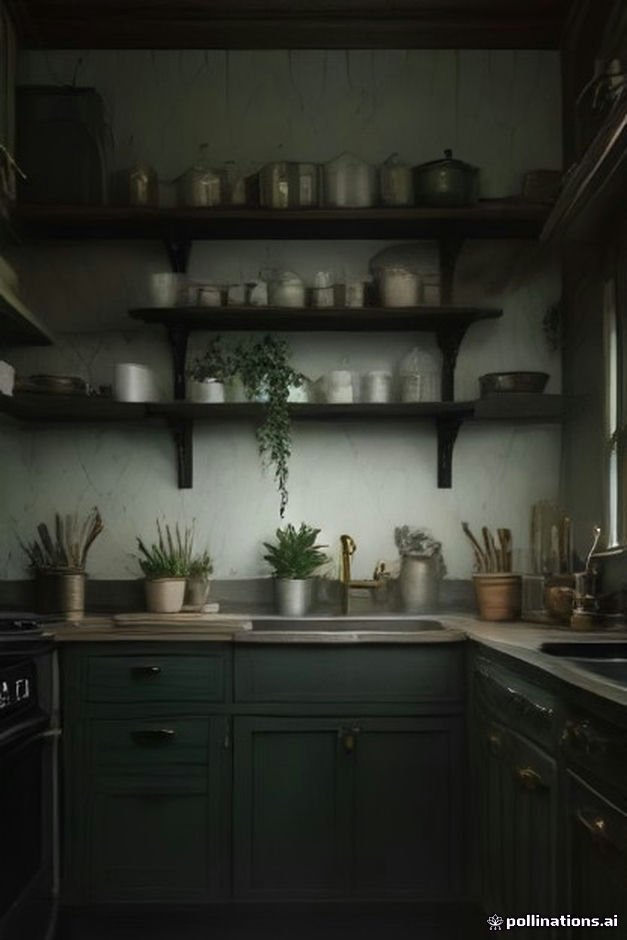
If there’s one move that defines dark cottagecore, it’s deep forest green cabinetry. Not sage. Not mint. We’re talking the green of old-growth moss, of ferns in the shade, of a forest floor after rain. Pair it with aged brass hardware, a Belfast sink, and open shelving stacked with mismatched earthenware.
The effect is immediate: your kitchen suddenly looks like it has stories. Chalk paint in forest green shades works beautifully on existing cabinets without a full replacement — Rust-Oleum and Annie Sloan both do excellent deep greens.
2. Burgundy Cabinetry with Lace-Print Tiles
Rich refectory red and burgundy is having a serious moment in dark cottagecore kitchens. The key is resisting the urge to soften it — lean in. Pair it with lace-embossed tiles in warm cream or sepia, unlacquered brass taps, and an aged copper or slate countertop. The result is “country kitchen that’s been haunted for three hundred years” and we mean that as the highest possible compliment.
If you’re renting, burgundy peel-and-stick wallpaper on a single accent wall behind open shelving gives the same energy without the commitment.
3. Open Shelving as a Dark Maximalist Gallery
Open shelving in a dark cottagecore kitchen is not about organization. It’s about curation. Stack mismatched pottery from different eras and origins. Mix pressed botanical prints in dark frames with actual dried bundles of herbs. Stack cookbooks with cracked spines. Add a skull or two. A glass jar of something mysterious.
The rule is: if it could have been found at an estate sale in rural Wales, it belongs on your shelves. Antique brass shelf brackets add instant age to new floating shelves.
4. Black Countertops and Dark Stone
Black granite, honed black marble, or dark soapstone countertops are the foundation of a properly moody cottagecore kitchen. They absorb light beautifully, they photograph like a dream, and they make everything on top of them look intentional.
If a full countertop replacement isn’t in the budget, black marble contact paper has gotten genuinely good in recent years. Pair with a cast-iron pot rack overhead and a Belfast sink and no one will look at the countertops too closely.
5. Dried Herb Bundles and Ceiling Botanicals
Nothing says dark cottagecore kitchen like bundles of dried herbs, flowers, and botanicals hanging from the ceiling. Lavender, rosemary, dried roses, poppy heads, eucalyptus, wheat — the more the better. This is free if you grow them, deeply atmospheric, and photographs beautifully.
Add a wrought iron ceiling pot rack and hang your cast iron and copper pans alongside the dried botanicals for a kitchen that is genuinely living and breathing.
6. Aubergine and Plum Accents
Pinterest searches for aubergine in kitchens are up 495% — and it works beautifully in a dark cottagecore context. You don’t need to commit it to cabinetry. A set of deep plum kitchen accessories — ceramic canisters, a KitchenAid in plum, linen napkins in aubergine — adds the color without the full renovation commitment.
Or go bolder: aubergine lower cabinets with forest green uppers. Clashing, maximalist, completely eclectic. Perfect.
7. Antique Dresser as Kitchen Island
The dark cottagecore kitchen resists uniformity. One of the most effective moves is replacing or supplementing your kitchen island with an antique piece of furniture — a farmhouse dresser, an old butcher’s block table, an ornate Victorian sideboard.
Sand and seal the top for a working surface, add hooks on the side for copper pans, and style the shelves below with baskets and crockery. It costs less than a custom island, it has actual character, and it makes your kitchen genuinely one of a kind. Check local estate sales, Facebook Marketplace, or Craigslist for finds.
8. Stained Glass Window or Transom
Even a small stained glass panel in a kitchen window transforms the entire room. When the light comes through in jewel tones — deep ruby, forest green, cobalt — it hits your dark countertops and moody cabinetry and the whole room comes alive.
Reclaimed stained glass panels can be found cheaply at salvage yards and architectural antiques dealers. Alternatively, stained glass window film applied to existing glass gives a convincing effect for under $30.
9. Dark Floral Wallpaper on One Wall
The single most dramatic renter-friendly move in a dark cottagecore kitchen: one wall of dark botanical wallpaper. We’re talking midnight black or deep forest green ground, overscale botanical prints, possibly with birds or insects woven in. Peel-and-stick versions exist and are genuinely convincing on a smooth wall.
Use it as the backdrop for open shelving, or behind your cooker/range to create an instant focal point. Dark botanical peel-and-stick wallpaper options have exploded in recent years — look for Morris & Co. inspired prints.
10. Mismatched Dark-Toned Pottery and Ceramics
The dark cottagecore kitchen does not want matching sets. It wants ceramics that look like they were collected across decades and continents: a Japanese black-glazed teapot next to a chunky Welsh slipware jug next to a Victorian majolica bowl. Dark-toned glazes — charcoal, forest green, midnight blue, deep terracotta — are your palette.
Display them on open shelving, hang plates on the wall with antique plate hangers, cluster them on the countertop. The more eclectic the mix, the more authentic it reads.
11. A Proper Witch’s Pantry Corner
Designate a corner or alcove as your pantry corner and go full apothecary with it. Dark glass jars labeled in script, bundles of botanicals, a mortar and pestle, a small brass scale. Shelves in a dark wood or painted black. If you have a corner with a small window, all the better — a lace curtain half-drawn over it makes the whole thing feel like a nineteenth-century herbalist’s shop.
This is one of those corners that gets pinned obsessively and costs almost nothing to create if you already cook from scratch.
12. Copper and Unlacquered Brass Hardware
Hardware is the jewelry of a kitchen, and in the dark cottagecore world, the only acceptable metals are copper, unlacquered brass, and aged iron. The key word is unlacquered — you want the brass to darken and patina naturally over time, developing the kind of age that makes everything look like it’s been here for a century.
Unlacquered brass cabinet knobs and pulls are the fastest single upgrade you can make to an existing kitchen — they transform flat, builder-grade cabinetry instantly. Budget around $5–15 per handle.
13. Layer Your Lighting Like a Victorian
The dark cottagecore kitchen is never lit by a single overhead fixture. The Victorian layered candles, gas lamps, and firelight across a room, and you should approach your lighting with the same philosophy: multiple sources, all warm, none harsh.
Start with a dramatic statement pendant — a gothic lantern pendant or a dark iron cage light above the island. Add under-cabinet warm LED strips. Put candles everywhere you can safely. Add a plug-in sconce if your rental allows. The goal is a kitchen that could be lit by firelight and would look even better for it.
The Dark Cottagecore Kitchen Mood Board Checklist
- Deep forest green, burgundy, aubergine, or charcoal cabinetry (or paint-your-own)
- Unlacquered brass, aged copper, or wrought iron hardware
- Open shelving styled as an eclectic gallery
- Mismatched dark-glazed pottery and ceramics
- Dried botanicals hanging from ceiling or pot rack
- Dark countertops: black granite, soapstone, or slate
- Layered warm lighting — pendants, candles, under-cabinet strips
- One statement botanical wallpaper wall
- A piece of antique furniture doing kitchen duty
- A touch of stained glass for colored light
Frequently Asked Questions
What is dark cottagecore style?
Dark cottagecore is a maximalist, moody evolution of the classic cottagecore aesthetic. Where traditional cottagecore leans into pastel softness and light-filled spaces, dark cottagecore embraces deep colors, aged textures, botanical abundance, and an atmosphere that feels ancient, earthy, and slightly witchy. Think: a kitchen that could belong to a hedge witch who also has excellent taste in ceramics.
What colors are used in a dark cottagecore kitchen?
The core palette is forest green, burgundy, charcoal, aubergine, midnight black, and dark terracotta. Accents come through in aged brass, copper, and rust tones. The overall effect should feel like autumn light through old trees — rich, layered, and deeply atmospheric.
How do I make my kitchen look cottagecore without renovating?
The highest-impact renter-friendly moves: replace cabinet hardware with unlacquered brass, add peel-and-stick dark botanical wallpaper to one wall, hang dried herb bundles from the ceiling, style open shelving (or add a freestanding shelf unit) with mismatched dark pottery, and layer in warm lighting. You can fully transform a kitchen’s feel for under $200 without touching a single permanent fixture.
Is dark cottagecore the same as goblincore?
They’re closely related but distinct. Goblincore is specifically about collecting odd, found, and forgotten objects — crystals, bones, mushrooms, things found in the woods. Dark cottagecore is broader: it’s about moody, atmospheric domesticity rooted in nature and the handmade. A goblincore kitchen would definitely qualify as dark cottagecore, but not all dark cottagecore is goblincore.
What kitchen hardware works best for dark cottagecore?
Unlacquered brass, aged bronze, wrought iron, and copper. Avoid anything chrome, nickel, or stainless — they’re too clean and cold for the aesthetic. The goal is metal that looks like it has a past.